The Fiji Revenue and Customs Service (FRCS) Board announced today that FRCS Director Border Mr. Jonetani Vuto has been appointed as the Interim Chief Executive Officer to move the Organisation forward.
Mr Vuto has been with FRCS for past 31 years and brings with him a lot of experience in terms on technical and strategic guidance that is required by FRCS. He has worked in all divisions within the FRCS including Compliance, Revenue, Border and Policy.
While thanking Mr Vuto for accepting the position, the FRCS Board stated Mr Vuto’s familiarity with the Tax Office and his breadth of experience will further strengthen the management and leadership of FRCS.
The Board also sincerely thanked outgoing acting CEO Ms Fane Vave for her years of service, dedication and leadership during her term in FRCS and wished her well in her future endeavors.
For further information, please email publicrelations@frcs.org.fj.
FRCS Launches New Services on Taxpayer Online Services (TPOS)
This media release announces that the Fiji Revenue and Customs Service will be increasing its online service offering with the automation of four processes in November.
The Fiji Revenue and Customs Service (FRCS) has announced today that four new online service modules will be available on its Taxpayer Online service (TPOS) from 3 November 2020.
The new services that will be available include (i) Tax Compliance Certificate (TCC), (ii) Taxpayer Requests for Remission of Penalties, (iii) Requests for Time to Pay Arrangements and (iv) Requests for Clarification.
Customers, who wish to access these services will therefore no longer have to physically visit the Tax Office to access these services, as from 3 November customers will be able to simply log onhttp://mytpos.frcs.org.fj to the Taxpayer Online Services and apply.
The first phase of the Taxpayer Online Services was launched in December 2019. The services currently available online includes Environment and Climate Adaptation Levy (ECAL), Fringe Benefit Tax, Telecommunications Levy, Value Added Tax (VAT) and Taxpayer Registration.
FRCS Acting Chief Executive Officer Ms. Fane Vave described the upcoming implementation of the four new service modules on the Taxpayer Online Services as a significant achievement for FRCS and a demonstration of its commitment to be a contemporary service oriented Organisation.
“I acknowledge the participation of different business segments, accounting firms, tax agents and individual taxpayers in our External Testers Program over the last 6 months whose feedback and input has been invaluable to test the online tax processes and are integral to our development and design process to ensure an optimal customer experience.”
Ms Vave encourages all taxpayers to access the online services and to contact FRCS on 1326 or info@frcs.org.fj, should they require any assistance on Taxpayer Online Services.
Further to the historic levels of direct government COVID-19 unemployment assistance, the Fijian Government has announced a new hiring subsidy- the Stronger Together Jobs Support Scheme- to incentivize employers to create employment for out-of-work Fijians. Employers approved as “Stronger Together Employers” will be granted a wage subsidy equivalent to the minimum wage rate for a three-month period when they employ eligible Fijians.
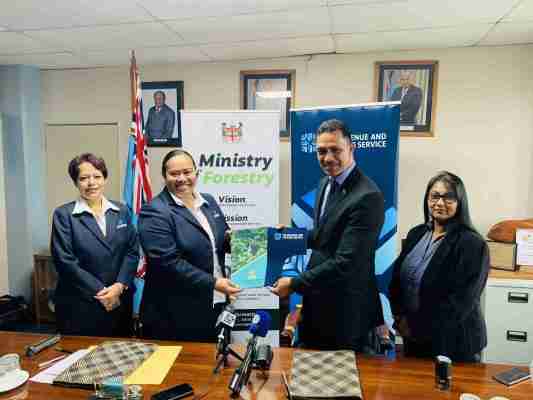
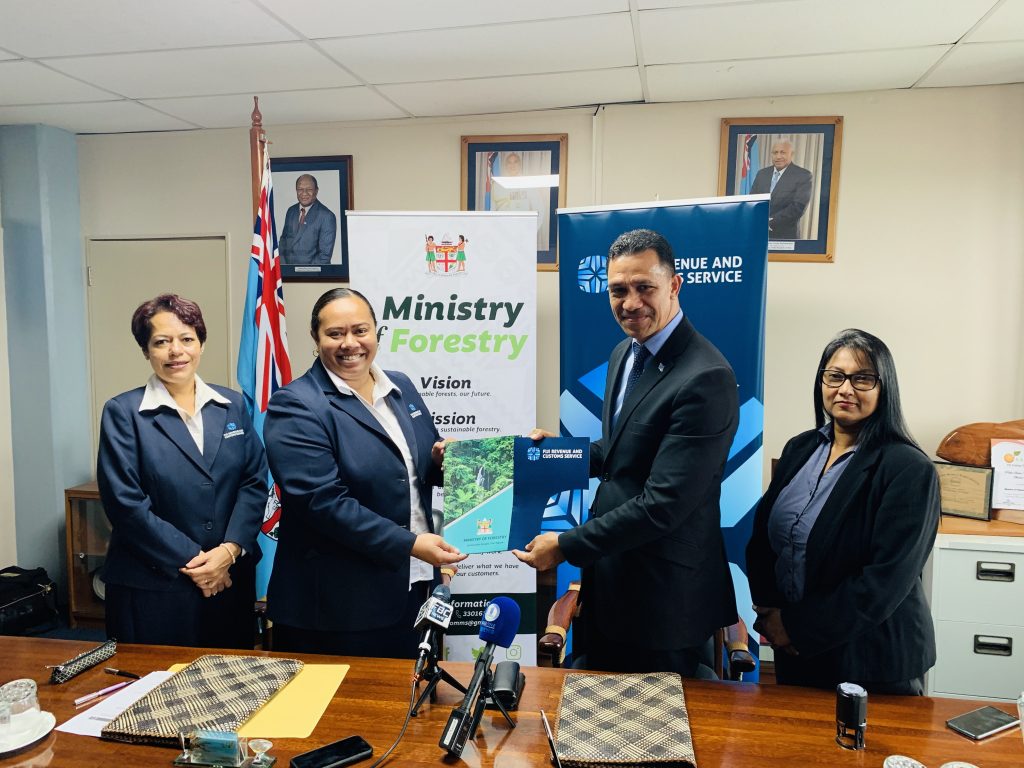
In an effort to collaborate and strengthen partnerships for efficient administration of Government’s revenue policies to support economic growth and improving tax compliance in the forestry sector, today the Fiji Revenue and Customs Service (FRCS) and the Ministry of Forestry (MoF) have signed a Memorandum of Agreement (MoA).
The Agreement formalizes a partnership between the two agencies to collaboratively work together to quantify economic benefits for both parties as well as ensuring tax and customs compliance within the industry.
Speaking at the signing this morning, Permanent Secretary for Forestry – Pene Baleinabuli said that the Agreement is a timely one as illegal activities within the Forestry sector is rife and needs to be curbed immediately.
“Activities like illegal logging is a major global problem that not only leaves an obvious mark of destruction on forests and ecosystems but it strips the economic livelihood of local communities, and responsible companies, depriving the nation of much needed revenue,” he said.
According to PS Baleinabuli, “this Agreement will allow the Ministry and FRCS to put up safeguards on two fronts – at the border and at its source. If we cut off their supply, illegal operators will have no choice but to close down.”
The MoA, amongst other issues, will facilitate information exchange between the two agencies that will be useful in the approval and monitoring of various forestry sector concessions, Customs clearance matters relating to timber imports and exports and more importantly, in the overall tax compliance activities relating to operators in the forestry sector.
Both the Ministry of Forestry and the Fiji Revenue and Customs Service are also making renewed efforts to help the private sector to grow the economy.
“This is particularly important in a post-COVID19 era. We need to work with the private sector because it is the engine for economic growth. It creates employment and pays taxes.”
Agencies like the Ministry of Forestry is repositioning itself to support and facilitate the needful so that the private sector could do what it does best- and that is to contribute to livelihoods and grow the economy.”
FRCS Acting Chief Executive Officer, Ms Fane Vave stated that whilst there has been an overall improvement in tax compliance in Fiji, there is no doubt that the black economy such as the exchange of cash in the primary sector is not properly accounted and declared to FRCS.
“The MoA will greatly assist FRCS to be fully aware of all the operators who are connected with the forestry sector which will then lead to a development of targeted tax compliance strategies”, Ms Vave said.
This is the first of many partnership Agreements that the Ministry will be formalizing with other Government agencies, statutory bodies, industry stakeholders and the private sector.
The MoA is merely a critical component of Government’s facilitation process to ensure we are capturing the correct information on revenue flows in the forestry sector.
Our other very important components include the quick turnaround time and quality facilitation for the sector in accordance with the existing regulations.
It also includes the provision of scientific and technical information based on applied research that will ensure operations in the sector have minimal impact on the environment and that in the longer term, Fiji is able to sustainably manage Fiji’s forest resources.
The Agreement between the Ministry of Forestry (MoF) and the Fiji Revenue and Customs Service (FRCS) also extends to information sharing with regards to the import and export of timbers products and machinery.
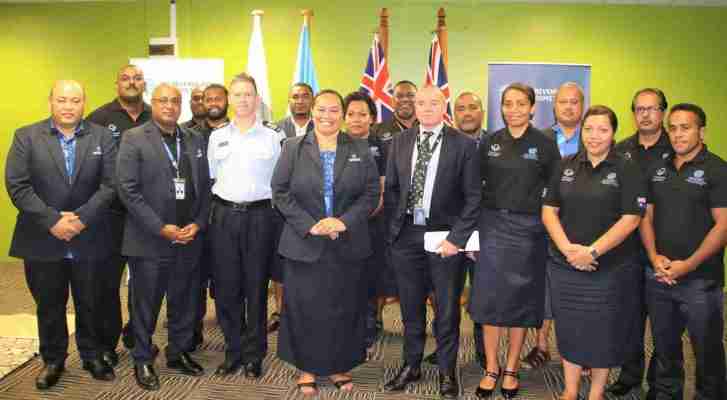
The Fiji Revenue and Customs Service (FRCS) has taken another step towards strengthening security at the borders with the launch of the Container Control Programme (CCP) in Fiji today at the FRCS Complex in Nasese, Suva.
The United Nations Office on Drug and Crime (UNODC) and World Customs Organization (WCO) Container Control Programme (CCP) will strengthen Fiji’s ability to process containers that pass through the nation’s ports. CCP focuses on improving risk management, supply chain security and trade facilitation in sea, land and air ports to prevent the cross-border movement of illicit goods.
The CCP has been funded by the Australian Border Force (ABF) as part of its commitment to work together with Pacific nations to strengthen regional borders. The ABF partnered with UNODC and WCO to implement the CCP and the Cargo Targeting System in Fiji – a system funded by Australia through the Fiji – Australia Vuvale Partnership.
FRCS Acting Chief Executive Officer Ms Fane W. Vave acknowledged the valuable support and collaboration with the WCO, UNODC and the Australian Government through the ABF in the establishment of the Container Control Programme.
“This is a significant accomplishment for Fiji as we are the first Customs Administration within the Oceania Region to administer the Container Control Programme,” Ms. Vave said.
“Fiji is a central hub for sea and air cargo in the Oceania region and has trade links to Australia and New Zealand as well as other countries. The creation of a dedicated risk profiling team to identify potential illicit and non-compliant shipments will mark another step of FRCS to address threats in the region”.
Ms Vave emphasised on the commitment of FRCS in targeting illicit trade and the readiness to cooperate with the global Customs community.
“We recognise that containers represent a major part of trade flows between Fiji and the rest of the world. The Container Control Programme will help us identify high risk containers and prevent drug trafficking and other illicit container crimes.”
Speaking at the launch, chief guest and Australia’s High Commissioner to Fiji, John Feakes, said Australia remains committed to working together with Fijian authorities to enhance regional border security and further strengthen the relationship.
“Every day Fiji and Australia are working together to combat shared border security challenges in the Pacific region. This program is another step to strengthen this longstanding relationship, and will protect Fiji and Fijian trade.”
For further information, please email on publicrelations@frcs.org.fj.
The Fiji Revenue and Customs Service (FRCS) is compelled to correct the record on a poorly photo-shopped image of a fake e-mail relating to a former CEO of FRCS.
“Notwithstanding obvious inconsistencies with usual FRCS correspondence, we have conducted an exhaustive search of our servers to verify that no such e-mail was ever sent across our internal network,” said Acting CEO Fane Vave. “We won’t allow FRCS’ independence to be undermined by anyone, particularly not by instigators on social media cowering behind keyboards. Moving forward, we ask the media to adhere to higher standards of fact-checking to assess the authenticity of such blatantly-manufactured images.”
Acting CEO Fane Vave has confirmed that the matter has been referred to the Fiji Police Force’s Cybercrime Division for further investigation.
For further information, please email publicrelations@frcs.org.fj.
The Fiji Revenue and Customs Service (FRCS) is advising members of the public to be wary of fake Facebook and WhatsApp requests demanding them to pay ‘customs clearance fees’ before their goods are released to them.
Information gathered by FRCS revealed that a number of Fijians have been tricked through fake Facebook, WhatsApp and Messenger requests advising them that the goods they have imported were being held by ‘Customs’ and that they need to pay ‘customs clearance fees’ into numerous local bank accounts that are being provided by the scammers through social media.
This money is then withdrawn from bank accounts by swindlers and remitted through post office to their partners. The total cash involved in all transaction to date is FJ$ 31,620.
FRCS Acting Chief Executive Officer Ms Fane W. Vave clarified that payment for customs clearance are only done at Customs counters and through FRCS bank account.
“We will never ask people through Facebook, WhatsApp and Messenger to make payments. If people receive such requests, they can always call our Hotline number 1326 or email us on info@frcs.org.fj for verification,” Ms Vave said.
“Members of the public and social media users need to be vigilant as they can be victims to this type of scams. It is important for people to be aware of the scams happening.”
Ms Vave advised victims of this scam to report the matter to relevant authorities.
For further information, please contact on (679) 9926170 or email on info@frcs.org.fj; or dnarayan@frcs.org.fj .
FRCS Introduces Pop-up Service Desk and extends service hours to enhance customer service
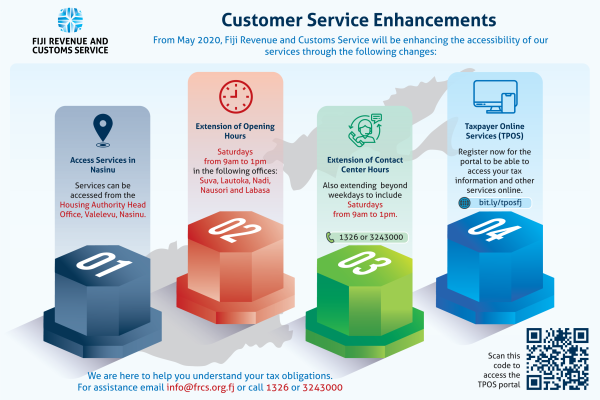
In a strategic move to expand its service delivery and demonstrate its commitment to sustainable improvement in customer services, the Fiji Revenue and Customs Service (FRCS) today announced its upcoming extension of service hours and introduction of a Pop-up Service Desk in Nasinu.
Effective from Friday 1 May 2020, FRCS will have Pop-up Service Desk at the Housing Authority of Fiji Head Office in Valelevu for ease of customers to access FRCS services.
In addition, from Saturday 2 May 2020, FRCS will be extending its operating hours for its Contact Centre service and Customer Service Offices in Suva, Lautoka, Nadi, Nausori and Labasa to Saturdays from 9am to 1pm.
“We understand that tax can be an intimidating topic to discuss for new entrepreneurs, small businesses and many people, therefore as an Organisation we need to simplify how we communicate and make ourselves more accessible so that it is easier for taxpayers to understand and comply with the tax rules. And more importantly, so that businesses and individuals can utilise the incentives and policies which are designed to benefit them,” said the Acting Chief Executive Officer, Ms. Fane Vave, while announcing this development.
“I acknowledge and thank Housing Authority of Fiji. And I reaffirm our commitment at Fiji Revenue and Customs Service to become a more service-oriented organization and deliver services to the taxpayers and business community,” emphasised Ms. Vave.
For further information, please email on info@frcs.org.fj.