Methamphetamine Seizure at the Suva Post Office

Officers from the Fiji Revenue and Customs Service (FRCS) and the Criminal Investigations Department arrested a woman this morning for allegedly importing 115grams of hard drugs- Methamphetamine through Parcel Post.

The drugs which were concealed inside a bottle of peanut butter arrived from the United States of America to Nadi on Wednesday and was addressed to a local person. Customs Officers at the Parcel Post scanned the consignment and discovered the white powder which was later tested positive for Methamphetamine.

“The parcel was then sent to the Suva Post office through control delivery and Officers arrested the lady when she came to pick the parcel today. The estimated cost of Methamphetamine is $115,000 with social cost associated to be around $210,000”, Chief Executive Officer Mr. Visvanath Das said.

“I commend our officers for carrying out their duties diligently in ensuring our borders are protected from the infiltration of illicit drugs. FRCS officers have been reminded to stay vigilant at all times and to foil attempts by smugglers who may take advantage of the busy passenger and cargo flows at the control points”.

“We are also maintaining close contacts with local and overseas enforcement agencies to strengthen intelligence exchange to combat the smuggling activities”, Mr. Das stressed.

Police Commissioner Brigadier General Sitiveni Qiliho is pleased that the partnership with other law enforcement agencies continue to produce positive results.

“Whether it’s a few grams or kilos, every seizure counts. If we are able to prevent one more innocent life from the harmful effects of the illicit drug trade, that in itself is a major victory for law enforcement”.

“Methamphetamine is being glamourized from what people watch on television and in the movies. The truth however, is that it is a danger to everyone in society, and a recent example was shared by a mother who said she knows and is in contact with a 16year old boy who has dropped out of school, assaulted his mother and sister, and stabbed his brother because of his addiction which is why we cannot allow Fiji to fall into drugs, because the dangers associated with meth is real and it has devastating consequences on everyone that comes into contact with it”.

Banks on Board for Real Time Tax and Customs Payments

The Fiji Revenue and Customs Service (FRCS) is working with the Bank of the South Pacific (BSP) and Bank of Baroda on a real time e-payments mechanism to be part of the New Tax Information System (NTIS) which will be rolled out in August this year.

Through this initiative, bank customers will use their respective online banking portals to make payments to FRCS and payments will be validated in real time against the specific tax types and amounts payable.

“Effective August this year, once you log into the New Tax Information System, you will be able to see the types of taxes that are due, the amount payable and the penalties that these overdue taxes have attracted. Once you have this information with you, log into your BSP or Bank of Baroda online banking portal and make your payments from anywhere, anytime. It saves time and is completely paperless”, CEO Mr. Visvanath Das said.

“These payments will be captured real time into our system and will be reflected in the taxpayer’s ledger same time. This will reduce the number of suspense cases we get. For Customs payments through ASYCUDA it will also mean that business won’t need to have a prepayment account with FRCS. They can keep their own money- earn interest on it and pay FRCS in real time even in the weekends”.

Association of Banks in Fiji (ABIF) Deputy Chairman Mr. Sudhansu Sekhar Khamari who is also the Chief Executive Officer for Bank of Baroda Fiji Operations while applauding the initiative said that money transfer between accounts usually takes a few minutes, while a wire transfer or a postal one may take several days. Customers will not waste their time waiting in lines. This will be convenient to customers. All transfers can be performed at anytime, anywhere.

The New Tax Information System (NTIS) is designed to assist the tax office to provide a wider range of tax services and more importantly it allows taxpayers to experience and access the wide range of tax services in a more convenient way.

We are simplifying and trying to create simplicity in the tax legislation and provide a reliable way where taxpayers are willing to comply. This New Tax Information System (NTIS) introduces an up-to-date online standard in Fiji where Tax services will be made accessible and ensures a higher level of compliance.

The new Tax system is also designed to assist taxpayers in a more personal way that allows them to access Tax services like requests for TIN and Joint Card registration, Tax Compliance Certificates, Tax Clearances, Tax Exemptions, Statement of Tax Accounts, Objections etc. online without having to visit any FRCS office.

To access a single tax service, the NTIS does not necessarily require the user to have a computer. In other words, users can access their tax services through android electronic gadgets such as phones, ipads, tablets etc. as long as there is accessible internet coverage.

ENDS

Border Fundamental workshop to enhance Border Protection

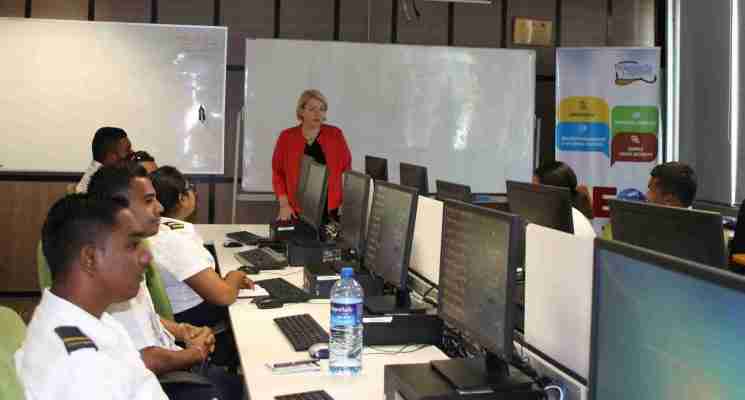
A week long workshop on Border Fundamentals is currently underway at the Fiji Revenue and Customs Service Regional Training Centre, Nasese, Suva.

The workshop organised by the Australian Border Force in collaboration with Australian High Commission and Revenue and Customs will enable participants from the Pacific region to enhance their skills to protect our borders.

Participants from 13 countries namely Commonwealth of Northern Mariana Islands, Cook Islands, Fiji, French Polynesia, Guam, Kiribati, Nauru, Niue, Palau, Papua New Guinea, Solomon Islands and American Samoa are attending the workshop.

Revenue and Customs Chief Executive Officer, Mr. Visvanath Das during his opening address stressed on the need to strengthen partnership and collaboration to combat border threats.

“We cannot combat threats at our borders alone. We must work collaboratively, actively seek to share information and look for opportunities to develop relationship with colleagues in the region,” Mr. Das said.

“Managing threats at the Border is a complex and challenging task. We frequently see evidence of our border officers making successful interventions, disrupting organised criminal syndicates individual opportunist seeking to do harm in the Pacific region,” Mr. Das said.

“Each of you have a wonderful opportunity this week to enhance your skills and learn from subject matter experts. We can always benefit by benchmarking and learning from others,” he added.

Mr Das acknowledged the partnership of Australia, Oceania Customs Organisation (OCO) and Pacific Immigration Development Community. 

Australian High Commissioner, Mr. John Freakes expressed similar sentiments.

“In today’s world, having strong border security has never been more important. We know that organised crime syndicates and people traffickers are active in these regions and can take advantage of any vulnerability that they can identify to circumvent our border security measures. And it is only through our strong partnerships and sharing information that we can collectively identify and manage those risks,” Mr. Freakes said.

“At times, you have to manage and carefully balance the competing factors of facilitation versus compliance. You have to make complex judgments and assessments within incredibly short time frames. The intent of this course is to provide you with the skills that will enable you to identify risks and manage threats at your borders,” he added.

The workshop will conclude this Friday (31/5/19).  


END

VMS Phase 3 Rollout

The Chief Executive Officer of the Fiji Revenue and Customs Service (FRCS) Mr. Visvanath Das announced the third phase of the Electronic Fiscal Device (EFD) regulation rollout plan this afternoon.

The phase three which was gazette on 18th May 2019 will cover the following groups of businesses and operators (tabulated below) and the deadline for these business to comply with the regulation is 31st July 2019.


Groups of businesses

Description

Accommodation

Includes hotels, boarding houses, lodging houses, guest houses and any building, vessel, premises, structure, caravan or house on wheels not being a public institution used for the business of receiving guests or travelers for any period of time or to which persons are entitled to resort for accommodation for hire or reward of any kind.

Architecture and engineering

Includes architectural and engineering activities and related technical consultancies.

Commercial health care services

Includes the provision of health care services on a commercial basis such as private hospitals, general or specialty medical and surgical hospitals, sanatoria, nursing homes, asylums, rehabilitation centers, medical practices, dental practices, allied health practices and optometry practices that are profit oriented businesses. 

Construction

Includes contractors and subcontractors in the construction or maintenance of buildings, construction of other civil engineering projects, demolition and site preparation, electrical installation, plumbing, heat and air-conditioning installation, other construction installation, building completion and finishing and other specialised construction activities.

Food services

Includes the provision of food or drink whether alcoholic or otherwise in exchange for money or consideration such as restaurants, bars, nightclubs, taverns and catering services.

Freight operators

Includes freight transport by road, sea and coastal freight water transport, inland freight water transport, freight air transport, warehousing and storage, service activities incidental to land transportation, service activities incidental to water transportation, service activities incidental to air transportation, cargo handling, other transportation support activities, postal activities and courier activities, including customs agents.

Real estate agents

Includes all real estate agent activities in relation to owned or leased property and any real estate agent activity on a fee or contract basis.

Service stations

Specialised stores involved in the provision of the retail sale of automotive fuel and other goods, servicing of vehicles and other services provided at service stations.

Wholesalers and manufacturers

Includes dealers, traders, manufacturers, wholesalers and distributers of goods for sale that purchase great quantities of goods for resale. This also includes hardware companies, supermarkets and pharmacies that are wholesalers or manufacturers.


In a press conference this afternoon, Mr. Das highlighted a list of all those taxpayers who need to be compliant before 31st July 2019 is available on the FRCS website and can be accessed through the following link https://www.frcs.org.fj/our-services/vat-monitoring-system-vms/.

“For businesses/individuals whose names are not on the list but fall under the business categories listed above are urged to update their information at any FRCS office nearest to them and voluntarily comply, as eventually all businesses will have to comply to the Regulations.

Mr. Das stressed that the objective of this system is not only to have efficient and reliable software to encourage voluntary compliance but at the same time collect the revenue due to government. It also plays a broader role in alignment to the government roadmap for development of Fiji, greater financial inclusion initiatives as well as push towards a cashless economy, addressing the black money challenges.

$0.35 Million Whistle Blower Reward Payout

The Fiji Revenue and Customs Service (FRCS) Board has approved a $0.35 million reward for a whistle blower that led to the recovery of $6 million in tax (excluding penalties).

This has taken the overall whistle blower pay out to $0.86 million yielding total tax and penalty collections of $28m since the introduction of the whistle blower policy in 2014.

FRCS Chief Executive Officer, Mr. Visvanath Das has revealed that the taxpayer in question is again a supermarket that has a number of chain stores around the country. He added that given the gravity of the offence committed, FRCS applied maximum penalties as it involved trust funds – the Value Added Tax. The total tax bill, in this instance, was $12million.

“The whistle blower informed FRCS of serious financial statement fraud committed by this supermarket to understate income tax and Value Added Tax (VAT). A systemic tax evasion strategy was executed by this supermarket to defraud the State with the legitimate revenue,” Mr. Das said.

The tax audit, which amongst other measures involved carrying out of a raid and independent third party information verification, found that the income statement and balance sheet of the company were manipulated such that taxes were evaded. “The supermarket, over the years, inflated trade creditors amounts, did not account for certain receipts other than direct supermarket sales, purchased properties in family names using company funds, over claimed zero rated sales, undeclared incomes from other parts of business such as milk bar etc. and engaged in general non-compliance behaviour,” Mr. Das added.

Mr Das is yet again giving stern warning to all taxpayers engaged in tax fraud that full brunt of tax laws will be applied which includes prosecution and seeking jail term. He reiterated that the Fijian Government has significantly reformed the taxation system that provides a very low tax burden and there is no incentive whatsoever to evade or avoid taxes. Tax laws, in recent times, have been modernized to seriously deal with any non-compliance behaviour.

“Let me make it very clear. Don’t even try defrauding, it’s not worth it. Therefore, I would encourage voluntary disclosure right away before it’s too late and you will have to face the full brunt of the law.”

If you have evidence of a business or taxpayer committing Tax or Customs fraud, you are encouraged to report through 9907740 | 9980489 or email directly to ceo@frcs.org.fj.

END

WCO Workshop on Time Release Study

A week-long World Customs Organization (WCO) Workshop on Time Release study (TRS) is underway at the WCO Regional Training Centre at Revenue and Customs Complex in Suva. The workshop is being attended by 40 participants from Fiji Revenue and Customs Service, Biosecurity Authority of Fiji, Department of Immigration, Ministry of Health and Medical Services and Fiji Ports Corporation Limited.

The facilitators of the workshop are Mr. Samson Bilangna, Senior Technical Officer from the WCO and Mr. Sompasong Amphaengphai, WCO TRS Accredited expert, Lao PDR Customs. The workshop is funded by the Customs Co-operation Fund Japan.

During the workshop, participants will learn and share experiences with the facilitators on the significance of carrying out a TRS and how the FRCS and other stakeholders involved in facilitating trade can benefit from the insight and findings of the TRS.

The expected outcomes of the workshop include:

  • Enhanced competence and confidence in the implementation of the WCO TRS tool, in collecting, recording and analyzing the data as well as reporting and conclusion of a TRS; and
  • Competence to build a base to conduct national TRS to support Customs-to-Government, Customs-to-Customs and Customs-to-Business initiatives.
  • FRCS and all stakeholders continue to work towards reducing the clearance time from the arrival until release of goods by finding ways to introduce additional trade facilitation measures.

While delivering the opening address on behalf of the FRCS CEO, the chief guest Mr. Fazrul Rahman (Director Revenue Management for FRCS), thanked all the agencies that agreed to participate in the workshop, emphasising the positive collaboration that has been enduring amongst the border agencies in Fiji.

He also re-iterated the need to appreciate the correlation between efficient border clearance processes to increase in trade and further to national economic growth. Furthermore, he also highlighted the need to identify where there is improvement needed. “We will know where we all stand and more importantly where the gaps or opportunities are that we must address. And we must address these.”

The workshop ends on Friday 21 December 2018.

END

Sub-Regional Workshop on Valuation

A weeklong Sub-Regional Workshop on Valuation is underway at the World Customs Organization (WCO) Regional Training Centre at Revenue and Customs Complex in Suva.

The workshop was officially opened by Chief Executive Officer, Mr. Visvanath Das who highlighted the need for developing countries to cope up with development in technology and move ahead with the rest of the world.

“Customs valuation is a core tool for customs administration around the world. Globally 98 per cent of the global trade accounts for transaction under the World Trade Valuation Agreement. This Workshop will feature a range of Customs valuation issues, including various articles of valuation, including the goods supplied under warranties, royalties, license fees and transfer pricing,” Mr. Das said.

“This workshop will deal with the nature and significance of customs valuation systems and practices and their international standardization. It will provide insights into the various case examples and examine the types of measures that could contribute to effective valuation of import shipments.”

Lead Facilitator Mr. Ian Cremer of World Customs Organization (WCO) stressed the need for striking a balance between Revenue collection and trade facilitation. “Commercial practices and processes are diversifying, pilferage of packages and e-commerce are some of the ongoing issues. Customs Officers should understand legitimate price practice especially those in the valuation area.”

Head of Regional Office for Capacity Building (ROCB) Mr. Kazunari Igarashi in his welcome speech told participants that WCO is discussing ways to support small island developing states in areas of International trade. “Manipulation of trade invoices are common occurrence and it is something that will be discussed in the workshop”.

The workshop is funded by WCO and supported by Japan Customs and ROCB. Twenty- four participants from Fiji, Tonga, Samoa, Vanuatu and Papua New Guinea are part of the workshop.

END

Information Sharing between FRCS and LTA

A Memorandum of Understanding (MOU) was signed between Fiji Revenue and Customs Service (FRCS) and the Land Transport Authority (LTA) this morning, which will encourage the promotion of mutual cooperation in the areas of information sharing and other related matters.

Under the MOU, both organizations will implement an effective framework on the collection of stamp duty on transfer of motor vehicles and public service vehicles permits.

“As stated in the MOU, both the parties agree that all transfers of motor vehicles and public service vehicles permits registered with LTA must be subject to Stamp Duty with exceptions in accordance with the requirements in the Stamp Duties Act 1920,” Chief Executive Officer Mr. Visvanath Das said.

“As part of the MOU, both organisations will pursue staff development joint training programs and staff exchange where appropriate and if necessary”.

“More importantly, LTA and FRCS will have controlled access to its online system database to assist in the administration and enforcement of their laws and LTA will provide the services required for the members of the FRCS Gold Card Services”, Mr. Das stressed.

LTA Board Chairman Vijay Maharaj said the signing of MOU was a milestone achievement for both the organisations and thanked FRCS for partnering with LTA.

“The MOU strengthens both the organisations that will not only make inter-organisational relationship more coherent but also make individual officers from the respective organisations more approachable and efficient.

“Although, we are two separate organisations with different strategic goals but our national goals are the same,” Mr. Maharaj said.

“Additionally, there are certain areas of work within the two organisations which are connected to each other and in some cases dependent on each other’s decisions.

Some of the areas which would be effectively covered under the MOU are;

  • It will promote and strengthen information sharing and develop mutual beneficial process of cooperation and exchange.
  • Enable organizations to provide controlled access to its online system to assist in the administration and enforcement of their laws.
  • Training opportunities and online systems.

END