
FRCS and Fiji Navy sign MOU

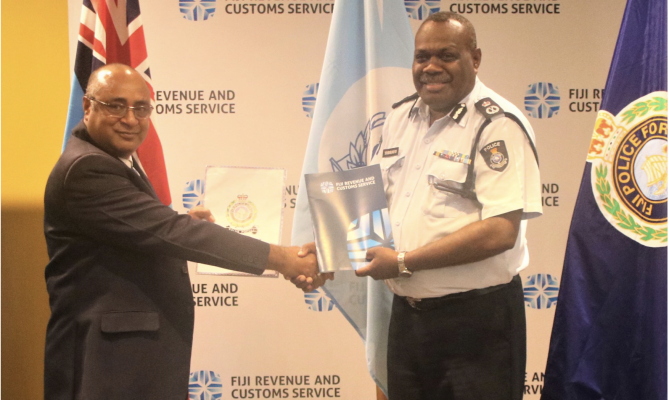
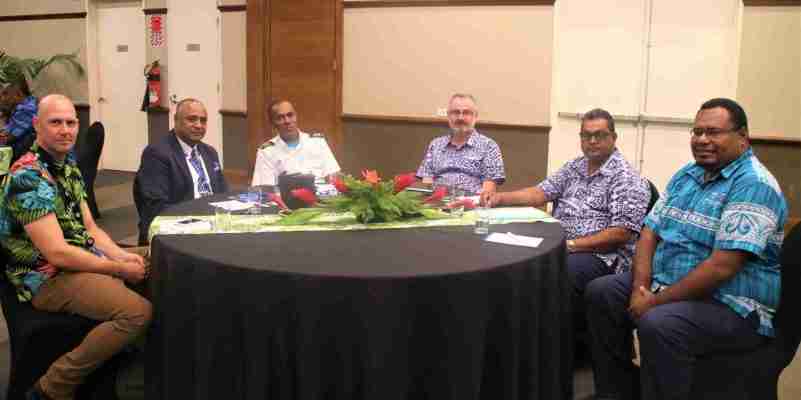
The Fiji Revenue and Customs Service (FRCS) and Republic of the Fiji Military Forces (RFMF) formalized their commitment to work in partnership in protecting Fiji from illicit trade and travel, at today’s Memorandum of Understanding (MOU) signing ceremony held at the Republic of Fiji Navy (RFN) Headquarters in Walu Bay.

The signing ceremony was effectuated by the FRCS Chief Executive Officer, Mr. Visvanath Das and the Commander Fiji Navy, CAPTAIN (N) Humphrey Tawake attended to by senior officials from both agencies.

The MOU cements FRCSs’ and RFNs’ (of the RFMF) commitment to cooperate and coordinate their resources (through Information Sharing; Specialist Training and joint Operations out at sea) for the sole purpose of protecting the integrity of Fiji’s sovereignty and Fijians, against transnational illicit activities. Such illicit activities include money laundry, importing of prohibited goods including arms and ammunition, etc.

Mr. Das said one of the Statutory responsibilities for both parties is to protect Fiji and this MOU will enable both parties to achieve this.
“FRCS will provide relevant trainings to RFMF officers relating to boarding, search and seizure of goods and Customs duties,” Mr. Das said.
“This MOU will enable both parties to share information relating to the movements of all vessels within Fiji Territorial Waters. The information shared will be used and handled responsibly within the parameters of the legal limitations,” Mr. Das added.

Mr. Das acknowledged RFMF for the partnership efforts.

“We are grateful to RFMF for agreeing to share information which will assist all of us. FRCS looks forward to a great partnership and cooperation for the betterment of Fiji,” he said.

The Commander of the Fiji Navy, CAPT. (N) Tawake reiterated the sentiments shared by Mr. Das adding that this partnership was well overdue.

“The Fiji Navy will provide the relevant support needed by the FRCS to effectively carry out its regulatory functions within the 12nmiles territorial waters of Fiji. With the shared vision of partnership amongst government agencies such as the one displayed at this morning’s MOU signing ceremony, the year 2020 seems to be a promising one; strengthening border security including Customs duty enforcement”.

END

FRCS Uncovers vehicle smuggling racket- staff sent home

The Fiji Revenue & Customs Service (FRCS) has uncovered what looks like a highly connected network of individuals working within the country with intent to make money from proceeds of criminal activities.

This after an Importer in the Western Division was recently investigated for allegedly smuggling four (4) Hilux vehicles into the country from overseas. These vehicles were imported between 2016 to 2019. Information has been ascertained that these vehicles were either reported stolen or were written off overseas thus the importation of this vehicles are prohibited under the Customs laws. The Revenue and Customs is also investigating two other suspected prohibited vehicle imports into the country.

“We uncovered the “modus operandi” being used is accident and insurance written-off vehicles are purchased and then the same number plates and road worthiness are used on illegally imported vehicles. We are collaborating with the Land Transport Authority to holistically crackdown on this illegal operation.”

“We are also investigating the fact that the vehicle frame or chassis numbers were altered and given a new look to conceal the alleged smuggling racket. All four vehicles have been detained by FRCS pending legal proceeding. Information received indicates that the vehicles came in a consignment marked as spare parts without any declaration of the vehicles”, Chief Executive Officer Mr. Visvanath Das said.

“‘During the process of investigations, two FRCS staff were also implicated as colluding to facilitate this illegal import. The Service has terminated their employment contracts instantaneously and is pursuing criminal prosecution”, CEO stated.

“We sought assistance from various Ministries, Private Sector Companies, the Australian Federal Police and Customs and the New Zealand Police and NZ Customs to investigate this matter. We realize that Border Security is a serious business and a collaborative approach should be taken with both local border agencies and international Customs Administrations globally to crack down on illegal activities. Under our Customs to Customs Cooperation arrangements intelligence sharing has intensified and we no longer work in isolation. While the Service is committed to facilitate trade, be rest assured that with the processes, systems and partnerships in place at the Border we will detect illegal activities”, Mr. Das said.

“We are grateful to credible Intelligence information received from the public in regards to the above smuggling case which led to the investigation and detention of vehicles. Members of the public are encouraged to report any Customs or Tax evasions or any unprofessional conduct by simply emailing to the Chief Executive Officer on ceo@frcs.org.fj  or a letter addressed to him or you can also report it in person.

END

FRCS announces Taxpayer Online Services Phase 1

The Fiji Revenue and Customs Service (FRCS) is pleased to announce the roll out of Phase 1 of its Taxpayer Online Services (TPOS) system.

“This has been a great collaborative effort and we’re now in a great position to rollout Phase 1 of the $48million transformation project, with the support of our specialist SAP partner Invenio Solutions,” FRCS Chief Executive Officer, Mr. Visvanath Das said.

In this first phase of Implementation, we are pleased to announce that the following services are now be available online.  

  1. Environment and Climate Adaptation Levy (ECAL) plastic Bag
  2. Environment and Climate Adaptation Levy (ECAL) prescribed services
  3. Fringe Benefit Tax (FBT)
  4. Service Turnover Tax (STT)
  5. Telecommunications Levy
  6. Value Added Tax (VAT)
  7. Joint Electronic Identification card /TIN card application
  8. New Tax Identification Number (TIN) registration

When we say services are available online, it means that customers can register, file tax returns and make online payments for all of the above services emphasized Mr. Das.

“The remaining Tax types will still be managed under the current Fiji Integrated Tax System (FITS) until the all the phases are rolled out,” he added.

Mr. Das said the new online system introduces an up-to-date online standard in Fiji where tax services will be made accessible, ensures a higher level of voluntary compliance and ultimately aims to enhance the customer experience.

Some of the benefits to taxpayers include the ability to;

  • register and file returns online;
  • fully integrated tax portal with multiple self-service features,
  • 24×7 access to services reducing visits to tax offices and
  • optimized user interface for ease of navigation and accessibility.

In order for customers to access the portal they must (I) Complete their one-time login code form (II) personally collect their one-time code from any FRCS office and (iii) Log unto the taxpayer portal.

The forms for the One Time Login Code can be accessed by clicking on the following link https://www.frcs.org.fj/our-services/taxation/taxation-forms/registration-change-of-address-forms/

Customers can access the portal on the following website https://tpos.frcs.org.fj/taxpayerportal

Mr. Das assures members of the public that regular updates will be communicated as the project progresses and acknowledged the invaluable contribution of stakeholders and Industry partners who have worked with FRCS in the design and testing phase of the project.

END

National Customs Enforcement Network Training

The Fiji Revenue and Customs Service (FRCS) in collaboration with World Customs Organization (WCO) is training Customs Officers on the use of National Customs Enforcement Network or most commonly known as nCEN.

Developed by the WCO, the nCEN application gives Customs administrations the ability to collect, store, analyse and disseminate law enforcement information more efficiently at the national level, in order to establish robust intelligence capabilities and enhance profiling.

“Through the adoption of the nCEN, administrations have the ability to manage information on all aspect of their law-enforcement functions, including seizures and offences and suspected persons or business entities, within a modern national system that can be standalone or used in a networked environment,” FRCS Chief Executive Officer, Mr. Visvanath Das said. 

“The Information Communication Interface (Icomm) included in nCEN allows administrations to exchange data with other nCEN users provided the existence of a legal premise, or to transfer the non-nominal components of the data directly to the global CEN database,” Mr. Das said.

Mr. Das said in order to face the challenges of the digital age, Customs administrations must commit to continuous improvement and modernization of their procedures and operational techniques.

“In a global economy based on information computerization, the nCEN enables Customs administrations to take large steps on the path to good governance, trade facilitation, stricter law enforcement and ultimately sustainable development and economic growth,” he said.

Mr. Das acknowledged WCO for their contribution towards the training.

WCO Facilitator Ms. Agnes Butrym-Bielatko said the network gives opportunity not only to collect the data but efficiently use this data for targeting and profiling.

More than 40 WCO member countries are using nCEN.

The training will conclude this Friday.

END

MOU to better serve members of the public

In a bid to better serve the people of Fiji, the Fiji Revenue and Customs Service (FRCS) and Fiji Public Trustee Corporation Limited (FPTCL) signed a Memorandum of Understanding (MOU) to share information.

The MOU was signed between FRCS Chief Executive Officer, Mr. Visvanath Das and FPTCL Chief Executive Officer, Mr. Atonio Takala this week.

“This MOU will enable both parties to share information for verification purposes.

The information shared will be used and handled responsibly within the parameters of the legal limitations,” Mr. Das said.
Mr. Das said one of the Statutory responsibilities for both parties is to serve members of the public and this MOU will facilitate to better serve the public.

“We deal with cases in relation to Estates, Wills and Trust on a daily basis. By sharing related information, it will not only expedite processes but enable us to update the data in the system,” Mr. Das said.

“Any changes to the relevant laws will also be communicated to FPTCL for compliance purpose,” he added.

Mr. Das acknowledged FPTCL for the partnership efforts.

“We are grateful to FPTCL for agreeing to share information which will assist all of us. FRCS looks forward to a great partnership and cooperation for the betterment of the people of Fiji,” he said.

FPTCL CEO, Atonio Takala welcomed the partnership, highlighting that the agreement was in line with the Corporations Strategic goals in strengthening stakeholder relationship to improve service delivery to the people of Fiji.

END

Tax Agents Undergo Taxpayer Online Services Training

Tax Agents are looking forward to the implementation of the Taxpayer Online Services (TPOS) portal.

This after Tax Agents attended training sessions conducted by the Fiji Revenue and Customs Service (FRCS) in Suva this week.

Mr. Jaswant Kumar, who runs his own Tax Agents firm ‘Just Fiji’ said the new tax system will make business easy for both FRCS and Tax Agents.

“The new online Tax system will make our work easier and faster. We will be able to trace our returns and it will make things easier for us. It will make work easier for FRCS as well in terms of updating the returns and collecting revenue,” Mr Kumar said.

Mr. Jerome Kado from PriceWaterhouseCoopers (PWC) who has been working closely with FRCS over the years said the training is vital for Tax Agents.

“It is relevant and important that Tax Agents undergo the training. You got to have quality inputs to get quality outputs thus the training is critical. We need to ensure that the system works properly,” Mr. kado said.

“As we move into the future, we have to move into adapting the latest technology if we are to properly function but ensuring that we have quality inputs,” he said.

Mr. Kado commended the efforts of the organization in ensuring the smooth implementation of the online Tax system.

“I would like to commend FRCS for taking this initiative but we need to ensure that we get the system and framework right before going live,” he said.

FRCS Chief Executive Officer, Mr. Visvanath Das said the aim of the training is to educate the Tax Agents before the online Tax system goes live.  

“The training sessions with stakeholders is vital to ensure Agents are well versed with the system. We also consult with them and take on board some of the suggestions for improvement,” Mr. Das said.

Tax agents are working closely with FRCS to ensure the framework and system is functional in a practical and efficient way.

The training for Suva Tax Agents concluded today followed by training sessions in the West and North on the 18th – 19th November, 2019. 

The TPOS is a self-service online platform that makes it easy for taxpayers to engage with FRCS. It is designed to allow taxpayers to experience and access the wide range of tax services in a more convenient way. Services that could only be accessed by visiting our offices will now be available online. This will include applications to register for a tax identification number (TIN), joint ID card, tax clearance certificates, filing tax returns, debt arrangements, etc.

Fill in the Taxpayer Online Services Signup form available on our website https://www.frcs.org.fj/our-services/taxation/taxation-forms/registration-change-of-address-forms/ and visit any FRCS office Fiji wide to collect your code. Overseas taxpayers may email their completed form to info@frcs.org.fj but will be required to attach scanned proof of identity documents.

END

Container Control Program

The World Customs Organisation (WCO) experts in collaboration with Australian Border Force (ABF) and Fiji Revenue and Customs Service (FRCS) are conducting the Container Control Program (CCP) training for FRCS Customs officers in Suva and Nadi.  

The United Nations Office on Drug and Crime (UNODC) and WCO launched the CCP to assist Governments in establishing effective container selections and controls to prevent drug trafficking and other illicit cross-border activities.

Fiji is the first country in the Pacific to have a future CCP unit.

“This is indeed a milestone achievement for FRCS. The CCP training will assist Customs officers and equip them with the right skills and knowledge to successfully operate the CCP unit in the near future,” FRCS Chief Executive Officer, Mr. Visvanath Das said.

ABF Superintendent International Operations, Mr. Bjorn Roberts said the current partnership between Fiji and Australia will further strengthen through this program.

“Australia Border Force already has a strong relationship with FRCS and through Australian Federal Police with the Fiji Police, this is just a next step in further strengthening this partnership to enable ongoing, real time operational collaboration to protect the region’s borders from the harm of transnational crime,” Mr. Roberts said.

“The first CCP unit is in Fiji because we see Fiji as the hub of the Pacific in terms of cargo movements. By strengthening Fiji’s borders, we can also protect the other Pacific nations,” he said.

He added that it is vital that border agencies work together to ensure that enforcement efforts do not interfere with the facilitation of genuine international trade. 

WCO facilitator, Mr. Peter Timmermans said the CCP unit focuses on illicit trade and identify by risk management techniques.

“We try to identify high risk containers for narcotics, wildlife, environmental crimes and also security,” Mr. Timmermans said

“At the moment for South East Asia, methamphetamine is quite a serious problem so we address and train officers on how best to access the information they need to be able to effectively target this threat,” he said.

A practical exercise was conducted at the Oceania Logistics this week with Customs officers and Suva Detector Dog unit.

Since its establishment 15 years ago, the UNODC/WCO CCP has achieved the following:

  • Establishment of more than 100 CCP units globally
  • 320,000kg of cocaine
  • Since start of CCP program, 6,907kg Heroine seized
  • 1723 tons Drug and explosives precursors seized
  • 72 ton of cannabis seized
  • 2755 Kilograms new psychotropic substances
  • 323-ton tramadol
  • Environmental crime: 183 Containers seized – Protected wood, hazardous and plastic waste, Ivory and rhino horn
  • 1951 other cases were reported with illicit trade such as weapons, dual use “strategic” goods (98), 914.660.000 pieces of smuggled cigarettes, spirits, stolen cars, counterfeit and smuggled medicines, illicit waste, ozone depleting substances and incorrect declarations increasing the National revenue collection.

END

MOU to strengthen partnership and assist Sugarcane Farmers

The Fiji Revenue and Customs Service (FRCS) in collaboration with Sugar Cane Growers Fund (SCGF) is committed to assist sugarcane farmers and ensure they are well informed on the cane farming incentives provided by the Fijian Government.

This after FRCS and SCGF signed a Memorandum of Understanding (MOU) aimed to enhance partnership and allow sharing of information.

The MOU was signed between FRCS Chief Executive Officer, Mr. Visvanath Das and SCGF Chief Executive Officer, Mr. Raj Sharma.

“The MOU is a tool to establish and enhance the cooperative relationship between both parties,” Mr. Das said.

“This MOU will enable FRCS and SCGF to assist farmers in helping their production grow. Farmers applying for loans from SCGF will have check and balances by both parties,” he said.

“For instance, when farmers apply for loans, one of the mandatory requirements is Taxpayer Identification Number (TIN). This is where FRCS will assist SCGF in providing the TINs and if farmers do not have a TIN, FRCS will assist these farmers for TIN registrations,” he explained.

“FRCS will also maximise the dissemination of cane farming incentives to cane farmers through SCGF and ensure cane farmers are well informed of the incentives which can be utilised for their production growth,” he said.  

“All the information shared will be handled by authorised officers within the legal limitations as outlined in the MOU,” he added.

Mr. Das acknowledged SCGF for joining hands with FRCS in assisting the sugarcane farmers.

“SCGF is first and foremost thankful to FRCS for this MOU. This MOU deepens our relationship with government agencies with an objective to serve our growers better, as mentioned by Mr Das,” Mr Sharma said.

“SCGF is going through transformation stage with change of its ICT system that requires updated grower information including TIN registration. Also we have difficulties in getting all the TIN registration for the growers to complete the Personal Security Registry and this is the means to fast track,” Mr Sharma said.

“This information will also assist SCGF to set up the Financial Transaction Reporting requirements platform,” he added.

 Mr Sharma said that this data would become one of the robust information pool for the sugar industry.