

Value Added Tax (VAT) remains the single largest contributor to Fiji’s tax revenue, consistently accounting for over 50% of total collections in recent years.
As a consumption-based tax, VAT plays a vital role in ensuring fiscal stability and supporting essential government services. However, the dynamics of VAT compliance are rapidly evolving.
New risks are emerging due to changing business models, digital platforms, and increasingly complex taxpayer behaviours, while long-standing issues around reporting accuracy, filing compliance, and transparency persist.
To safeguard VAT integrity, FRCS is implementing a modern, technology-enabled VAT compliance framework, supported by the upcoming rewrite of the VAT Act, which will align VAT administration with international best practices and Fiji’s evolving digital economy.
FRCS is committed to strengthening VAT compliance through a modern, technology-driven compliance framework combining taxpayer education, streamlined administration, enhanced enforcement, and collaborative partnerships. Central to this strategy is the expansion of the VAT Monitoring System (VMS) and the simplification of the VAT Act to encourage greater voluntary compliance and reduce system complexity. Through these efforts, FRCS aims to safeguard VAT integrity, ensure fairness across the tax system, and reinforce public trust in Fiji’s revenue administration
VAT Lodgment Compliance Monitoring:
FRCS continues to strengthen its ability to monitor and enforce VAT compliance through advanced data analytics and systematic lodgment tracking. Using VAT lodgment compliance data, FRCS has identified two key risk categories:
- Non-Lodgers: Taxpayers who have failed to lodge VAT returns despite continuing to operate and issuing VAT-inclusive (VIP) invoices.
- Nil Lodgers: Taxpayers who submit Nil VAT returns while actively transacting, raising concerns of under-declaration or false reporting.
VAT Trend Analysis
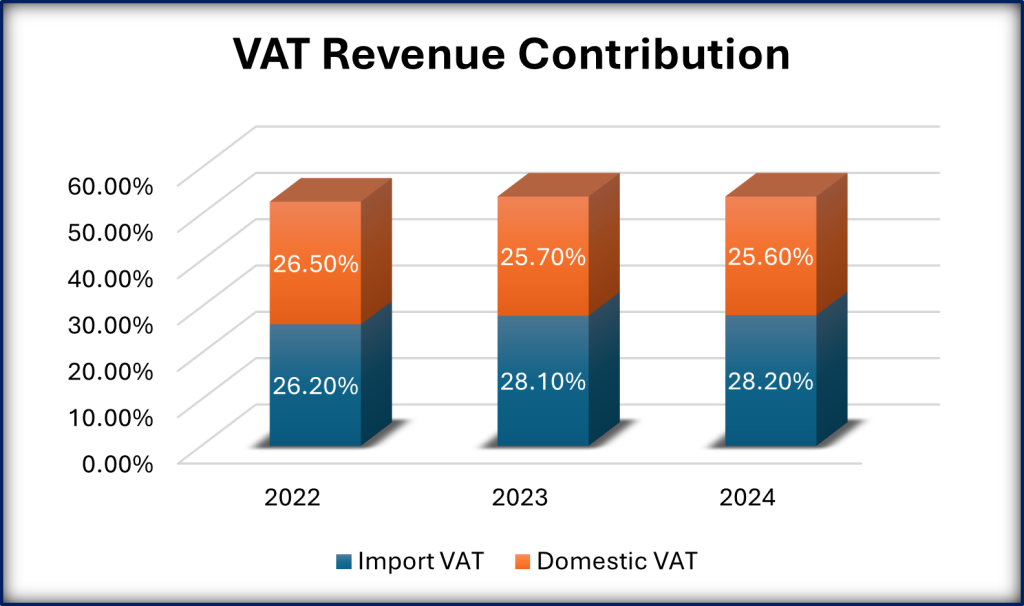
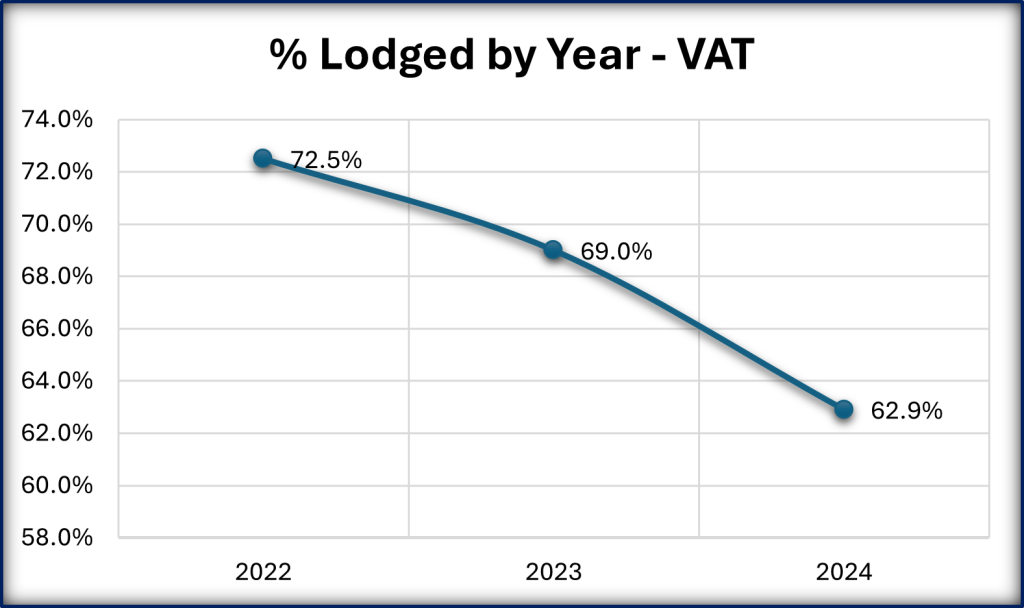
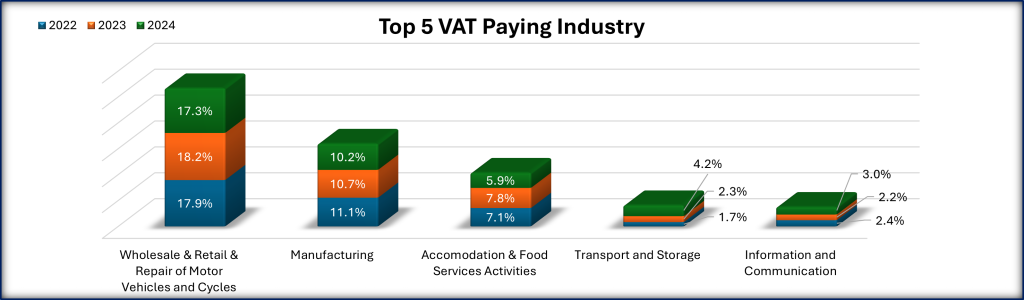
The above graphs shows In 2024, VAT contributed 53.81% of total tax revenue, highlighting its continued significance within Fiji’s broader revenue framework. Whereas, the VAT lodgment compliance has steadily declined, falling from 73% in 2022 to 63% in 2024 indicating increased filing delays, under-declaration, and growing risks of revenue leakage. The Wholesale & Retail Industry is the major VAT revenue contributor followed by Manufacturing Industry.
Risk Areas and Mitigation Strategies:
Helping you get VAT right – through clearer rules, smarter systems, and better support.
| Risk Area | Description | FRCS Mitigation Strategy |
|---|---|---|
| Non-Lodgement & Nil Lodgement | Businesses fail to file VAT returns or submit nil returns despite ongoing business activity. | Automated alerts and enforcement; targeted engagement campaigns; penalties for repeated non-compliance. VAT compliance campaigns |
| Duplicate Invoicing | Issuance of multiple invoices to claim input credits more than once. | Using data analytics to detection anomalies; cross-checking with supplier data; EFD and VMS integration to validate unique transactions. |
| Fake Invoices | Fictitious invoices are used to inflate input VAT claims or under-report sales. | Targeted desk audits; VMS real-time transaction tracking; prosecution; and tighter eligibility rules under revised VAT Act. |
| Cash-Based Transactions | Untracked cash sales lead to VAT under-reporting in sectors like retail, food, and hospitality. | Expansion of VAT Monitoring System (VMS); mandatory use of Electronic Fiscal Devices (EFDs); public education on transparent invoicing. |
| VAT on Digital Service Providers | Emerging e-commerce and digital service providers. | New obligations in the revised VAT Act for platform operators and non-resident suppliers; data sharing with payment providers and online marketplaces. |
| Manipulated Export/Customs Claims | False refund claims via misreported export values or fabricated customs declarations. | Strengthened Customs–FRCS data matching; high-risk audit targeting; new controls on export VAT refunds under simplified VAT Act. |
| Poor Record-Keeping & Misreporting | Incorrect documentation, incomplete records, or failure to retain required VAT records. | Improved taxpayer education; simplified VAT Act with clear record-keeping guidelines; applied audit penalties for poor documentation. |
| VAT Threshold Avoidance | Some businesses deliberately understate or split their turnover to remain just below the $100,000 threshold, avoiding mandatory VAT registration. | Monitor businesses with consistent turnover between $90,000 to $100,000 using data analytics and trend analysis. Data matching with third-party information. Also, conduct spot audits and outreach for high-risk cases. |
Last Updated - April 27, 2026