

The Large Taxpayer Segment, comprising 316 businesses with annual turnovers above $15 million, is the backbone of Fiji’s tax system, contributing over 66% to 70% of national tax revenue in recent years. These entities play a pivotal role in economic stability and fiscal sustainability.
Due to their complex financial structures, cross-border transactions, and exposure to sophisticated tax planning, these taxpayers pose unique risks, but also immense opportunity. They consistently demonstrate high lodgment compliance, reinforcing their role as primary revenue contributors.
Large Taxpayer Trend Analysis
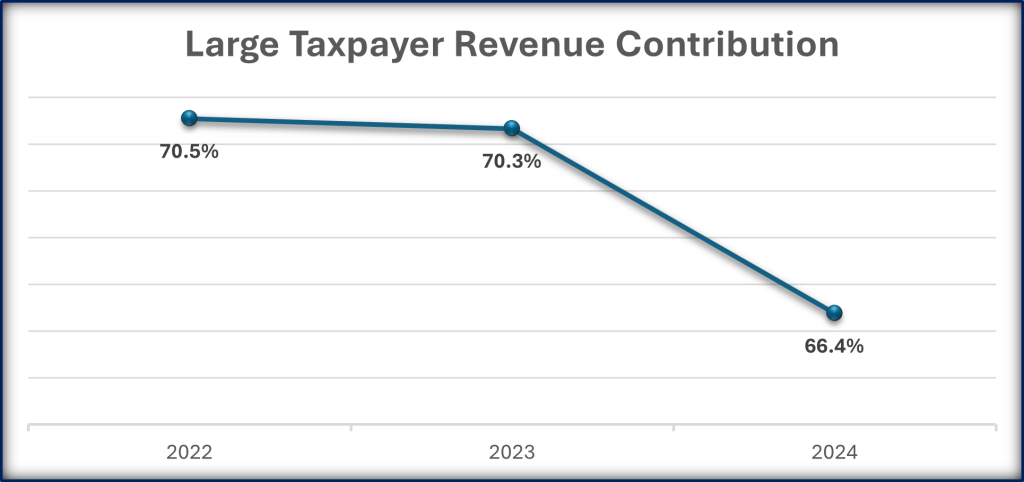
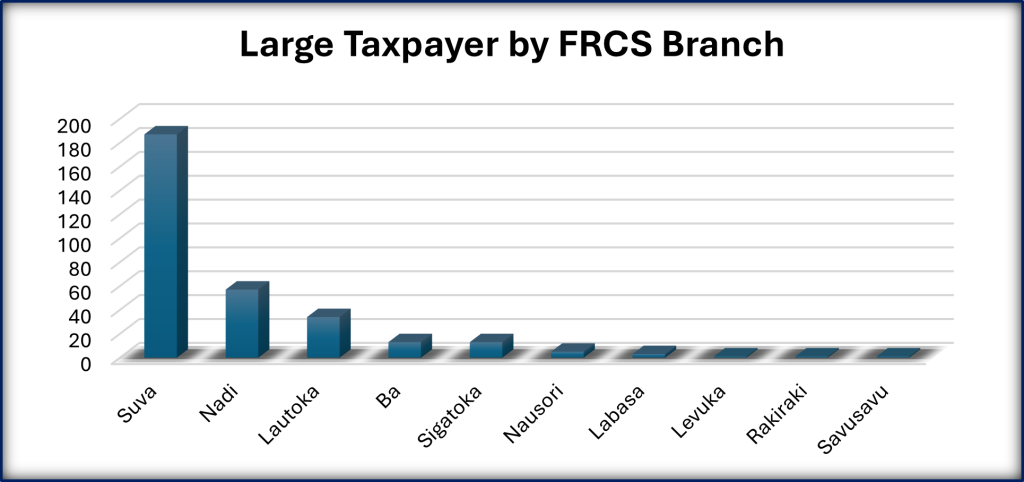
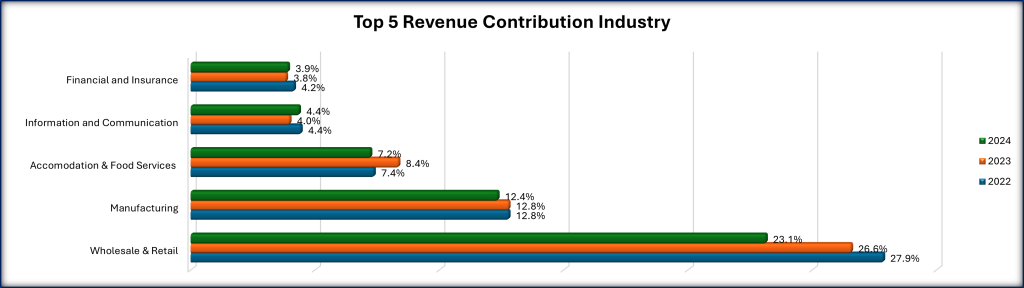
The graph reveals that large taxpayer revenue contribution is declining, dropping from 70.5% in 2022 to 66.4% in 2024, with the majority of these taxpayers managed by the FRCS Suva branch and the least by Savusavu. Industry-wise, wholesale and retail leads in revenue contribution, followed by manufacturing.
Risk Areas and Mitigation Strategies
Safeguarding Fiji’s revenue backbone – ensuring transparency, fairness, and full compliance from our largest contributors.
| Compliance Challenge | Description | FRCS Mitigation Strategy |
|---|---|---|
| Complex Financial Structures | Multi-layered instruments and transactions require deep risk assessment. | Conduct risk-based audits using Risk Differential Framework (RDF) and financial forensics; allocate specialist compliance teams. |
| Transfer Pricing & Cross-Border Risks | Exposure to profit shifting and base erosion through related-party trade. | Apply OECD-aligned Transfer Pricing rules; require robust documentation; coordinate with global tax partners. |
| Transfer Pricing Documentation Gaps | Risk of insufficient documentation on related-party pricing. | Mandate Transfer Pricing documentation, local files, and contemporaneous reports; penalize non-compliance. |
| Inter Company Related party transactions | Allocation of expenses and revenue; loans and advances | Targeted group audit. |
| Tax Planning & Avoidance Schemes | Use of offshore entities, financial engineering, and complex arrangements to reduce liabilities. Includes, abuse of concessions and undeclared offshore accounts | Deploy Risk Engine profiling to detect aggressive planning, and targeted audits to combat these schemes. Collabroate with internation partners to trace offshore assets. Tighten and monitor tax conession eligibility to preven misuse. |
| Late Filings & Disputed Assessments | Delays that impact cash flow and collection efficiency. | Strengthen debt recovery and dispute mechanisms; set strict timelines. |
Last Updated - July 17, 2025