

At FRCS, we are committed to delivering excellent customer service while helping all taxpayers and traders meet their obligations. We aim to make your experience with us as clear, fair, and efficient as possible.
We want our customers to feel confident and supported when navigating Fiji’s tax and customs requirements. Whether you are an individual taxpayer, a small business, or a large corporation, our goal is to provide you with the right information and assistance at every step.
Our customer service teams are empowered through the New Tax Information System (NTIS). This modern system streamlines our processes and enables faster, more accurate responses to your queries—whether online, by phone, or in person.
We continue to enhance our services by:
- Offering self-service tools through the TPOS portal
- Providing easy-to-access FAQs, video tutorials, and developing an AI-powered Chatbot to offer real-time assistance.
- Sending timely reminders and updates to help you stay on track
FRCS is focusing on making tax and customs simpler for everyone:
- More proactive education and awareness – especially for new and informal traders.
- Promoting easy digital services – use TPOS portal for filing and payments.
- Encouraging full income declaration – remind everyone of their full tax obligations.
- Personalized support – including through the coming AI-powered chatbot to answer questions in real time.
At FRCS, we believe that good service is key to building trust and promoting voluntary compliance. We are committed to supporting you and making it easier for everyone to comply with Fiji’s Tax and Customs laws.
Customer Service Trend Analysis
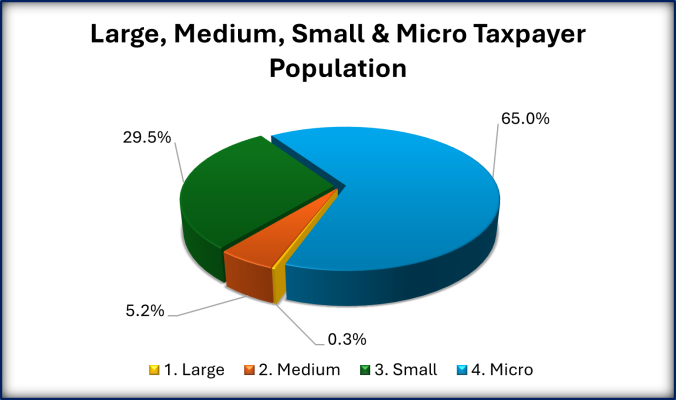
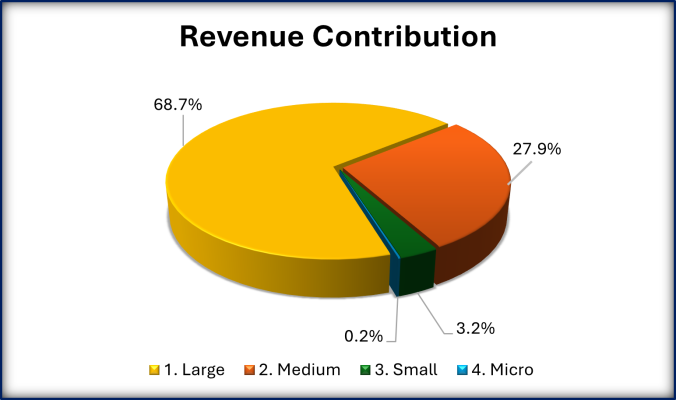
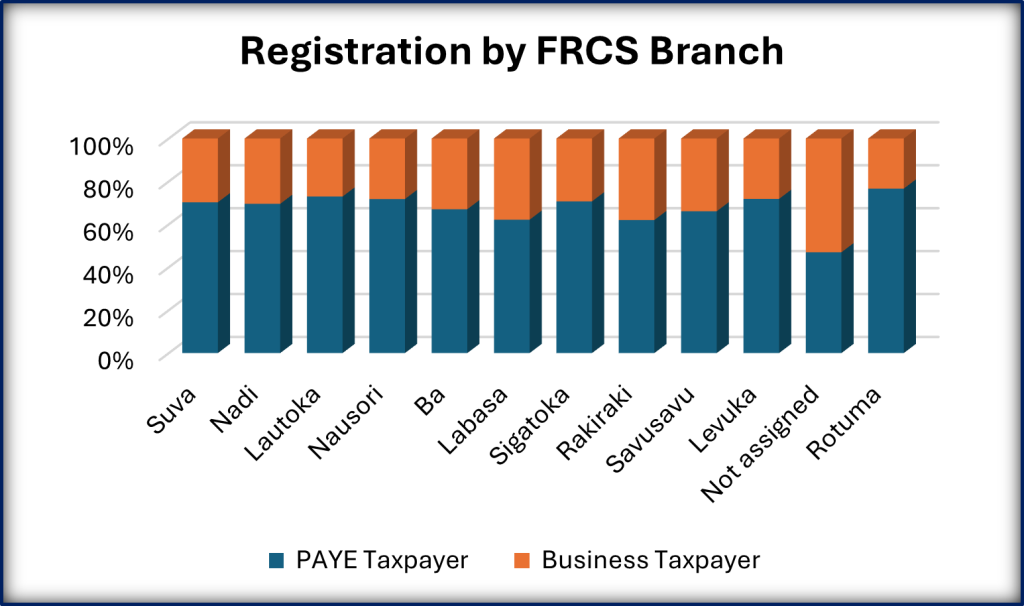
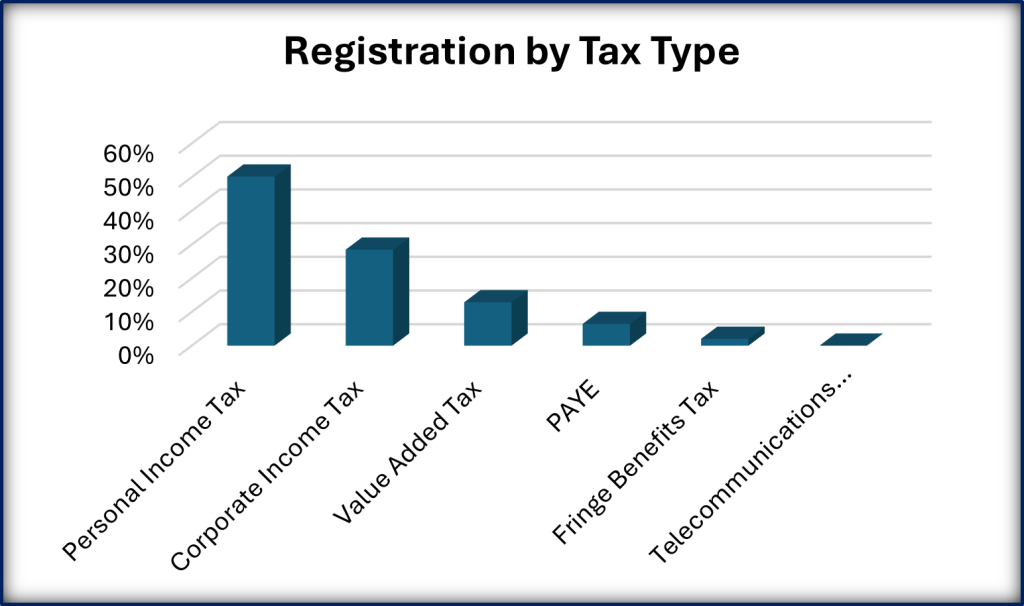
The above graph shows that Micro has the majority population while major revenue contributors are the large taxpayers. Furthermore, majority taxpayers is registered at the Suva branch following by Nadi and major tax type is Personal Income Tax followed while the least is Telecommunication Levy.
Risk Areas and Mitigation Strategies
Helping you understand where the risks are and how we are working to make Tax and Duties processes clearer, simpler, and fairer for everyone.
| Risk Area | How it Affects You | FRCS Mitigation Strategy |
|---|---|---|
| Late & Non-Lodgers | Some taxpayers and traders may file returns late or fail to file entirely (non-lodgement), often due to lack of clarity or limited awareness of their obligations. This can lead to penalties and missed opportunities for compliance. | We are simplifying customs and tax procedures and providing clearer policies. FRCS will increase proactive communication, automated reminders, and targeted education campaigns to support timely filing. For non-lodgers, we are strengthening early engagement, risk-based follow-up actions, and enforcement strategies to bring them into compliance. |
| Tariff Classification and Valuation Errors | It can be difficult to determine the correct value, classification, or origin of goods — which may result in delays, disputes, or incorrect tax. | You can request an Advance Ruling to clarify valuation, classification, and origin before importing or exporting. We also publish an annual Compendium of Tariff Classification Opinions and provide Standard Interpretation Guidelines online. |
| Non-Compliant Customs Agents | Some customs agents do not follow the correct procedures, which affects the accuracy and efficiency of customs declarations. | We have introduced a Demerit Point System to encourage compliance among customs agents, ensuring fair and accurate declarations. |
| Non-Compliant Tax Agents | Some tax agents may not adhere to required tax laws, procedures, or the Tax Agents’ Code of Conduct. This can result in inaccurate filings, misrepresentations, or delays that impact both the taxpayer and FRCS’s ability to ensure accurate tax compliance. | FRCS monitors tax agent conduct closely. Where complaints or non-compliance are identified, a formal investigation is conducted. If breaches of the Code of Conduct are established, the agent’s licence may be suspended or cancelled. Ongoing agent education and engagement promote professional standards and ethical compliance. |
| Misclassified Businesses | Some businesses may mistakenly register as salary and wage earners, affecting proper tax collection. | We are actively identifying such cases and helping businesses register correctly to ensure they meet the right tax obligations. |
| Undeclared Income | Some individuals or businesses may not declare their full income, particularly income earned online or through informal channels. | We run ongoing awareness campaigns about full income declaration requirements. We are also improving data matching across digital platforms and financial institution records to ensure transparency. |
| Complex Tax and Customs Procedures | Complex or unclear procedures may discourage compliance or create unintentional errors. | We are undertaking a comprehensive rewrite of key tax laws, to modernise and simplify tax obligations. We regularly publish Standard Interpretation Guidelines to clarify complex areas and assist taxpayers with correct application of the law. Taxpayers can also request Tax and Customs Rulings to gain certainty on specific matters. To further support compliance, we are developing an AI-powered chatbot to provide real-time guidance on tax and customs requirements, helping users navigate procedures more easily. |
| Adoption of Technology/Access to Taxpayer Online Services (TPOS) in Rural Areas | Not all taxpayers have the same level of technology literacy or reliable access to online services (TPOS), especially in rural and maritime areas. This creates barriers to digital compliance. | We are expanding awareness campaigns on TPOS, setting up mobile help desks and kiosks in rural hubs, and providing easy-to-understand guides and tutorial. Additional support is available through our customer service teams. |
Last Updated - April 27, 2026