

The Agriculture Industry is one of the most significant sectors of Fiji’s economy, supporting livelihoods across rural communities and contributing to national food security and exports.
The Agriculture Industry is a vital pillar of Fiji’s economy, supporting food security, exports, and livelihoods for thousands of rural and urban communities. However, the industry remains highly fragmented and largely cash-based, with a significant proportion of micro-enterprises and informal operators. This structure creates challenges for income tracking, tax compliance, and VAT reporting.
Recent analysis of registered taxpayers within the Agriculture Industry has identified multiple sectors contributing to varying levels of tax revenue and compliance behavior.
Various agricultural sectors contribute to the economy, with significant activity in root crops and vegetables, encompassing items like cassava, kumala, taro, yaqona, yams, and a variety of other produce including melons, bananas, watermelons, and ginger. Sugar cane cultivation represents a substantial portion of the agricultural landscape. Additionally, there’s production of spices, aromatics, and special crops, including pharmaceutical and fibre crops. Animal farming and production covers a broad range, from eggs and poultry to cattle, sheep, goats, pigs, and raw milk, alongside mixed farming and other animal rearing. Plant propagation and support activities are also vital, including post-harvest crop activities. Lastly, the growing and curing of tobacco also forms a part of this diverse agricultural output.
However, the sector also presents complex tax compliance challenges, primarily due to:
- High levels of informality
- Cash-based transactions
- Supply chain opacity caused by dominant middlemen and agents
These dynamics make it difficult to ensure accurate income reporting and tax contributions. While the agriculture sector remains critical to Fiji’s economy, its overall tax contribution remains relatively low – increasing gradually from 0.20% in 2022 to 0.22% in 2023 and reaching 0.25% in 2024. This trend highlights both progress and the ongoing need to improve tax compliance within the Industry.
The primary compliance risks do not originate from subsistence farmers, but from:
- Middlemen — who act as intermediaries but may under-declare taxable income or claim inappropriate tax benefits.
- Cartage providers / transporters — often informal operators incorrectly applying concessions.
- Large Aggregators / Processors — entities consolidating produce and conducting large-scale trade.
- Cooperatives — especially those transitioning from 5 – 8-year tax exemption back into the regular tax system.
- Targeted High-Value Supply Chains — we will also focus on farmers and suppliers involved in high-value agricultural products such as tobacco, taro, cassava, sugarcane, poultry, kava, ginger, and dairy. In collaboration with British American Tobacco, Rewa Dairy, companies purchasing taro, cassava, poultry products, Fiji Sugar Corporation, and by cross-verifying export data for kava, ginger, taro, and cassava to detect under-reported income and incorrect exemption claims.
Agriculture Trend Analysis
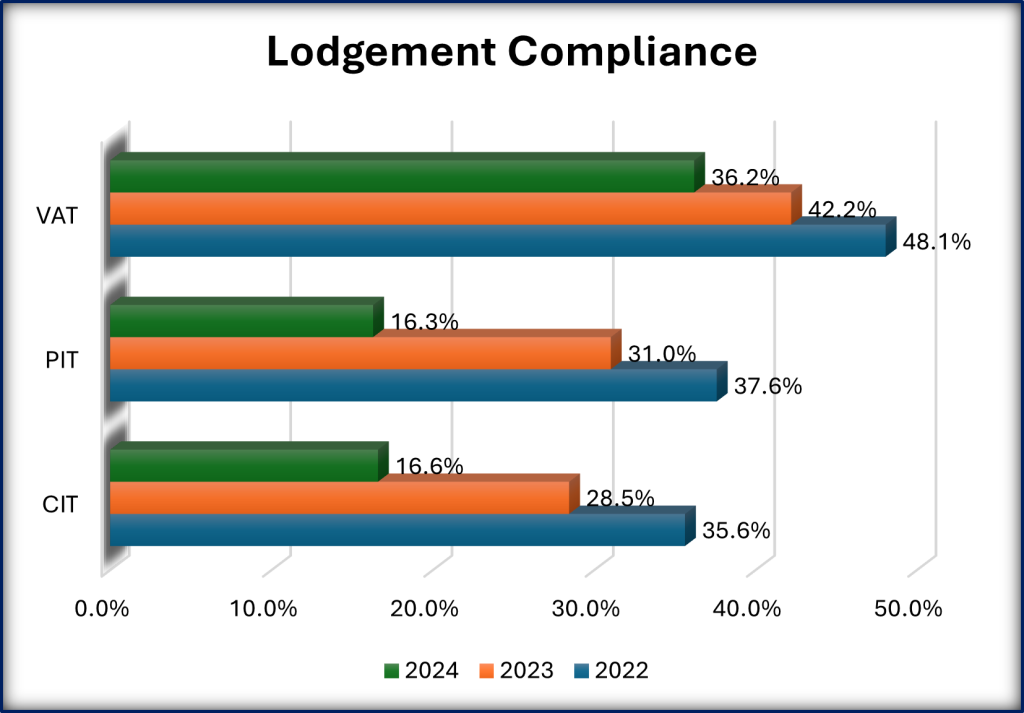
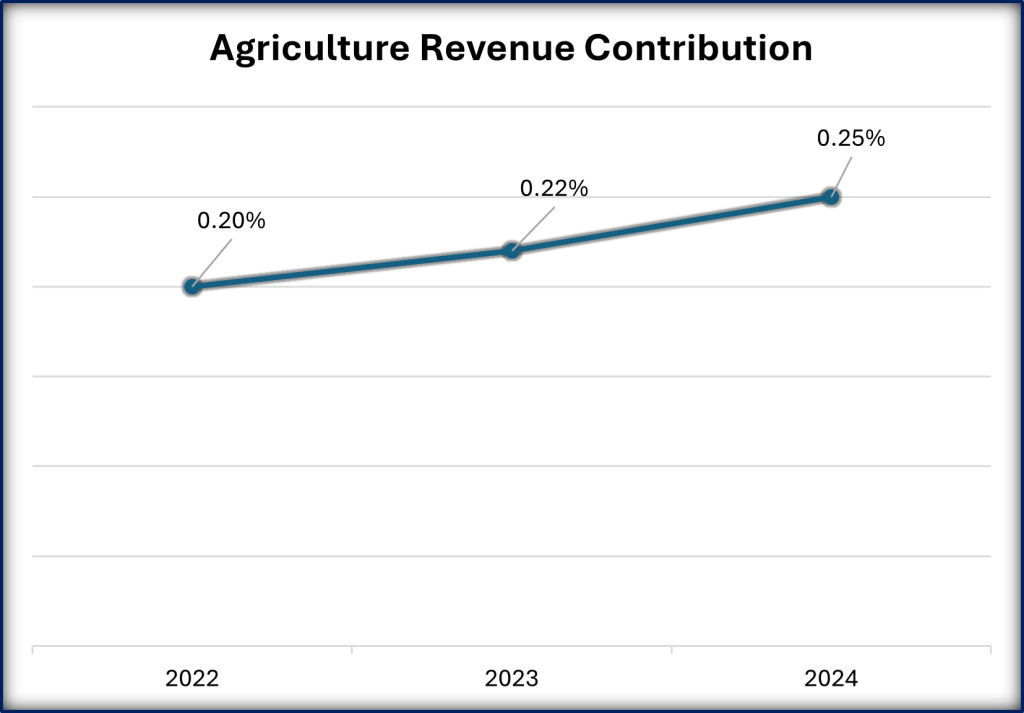
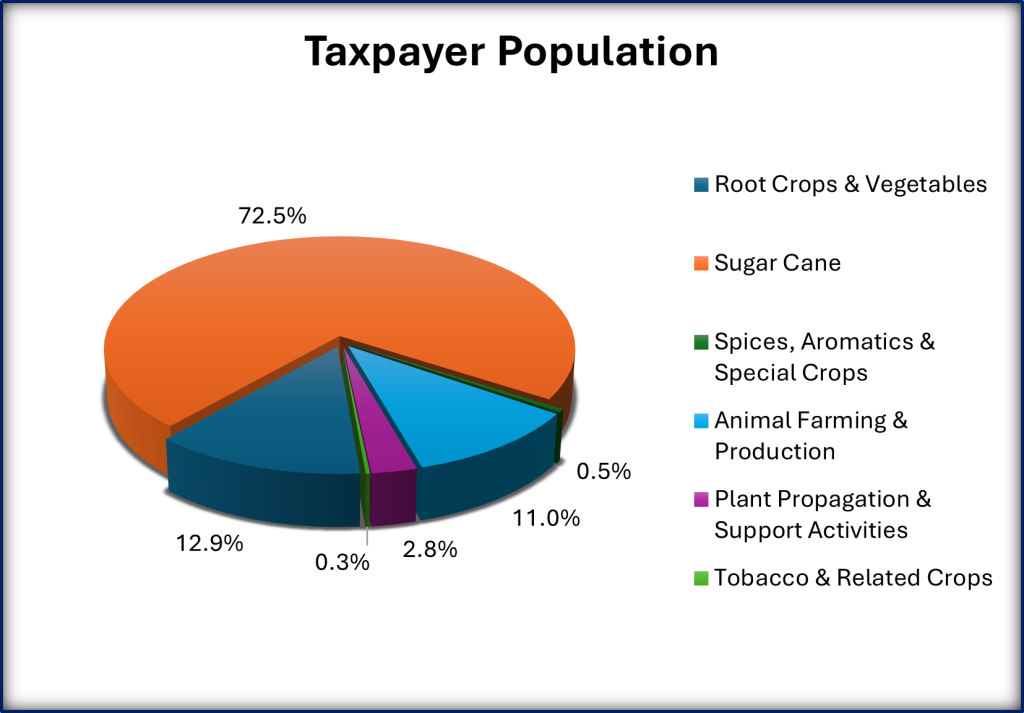
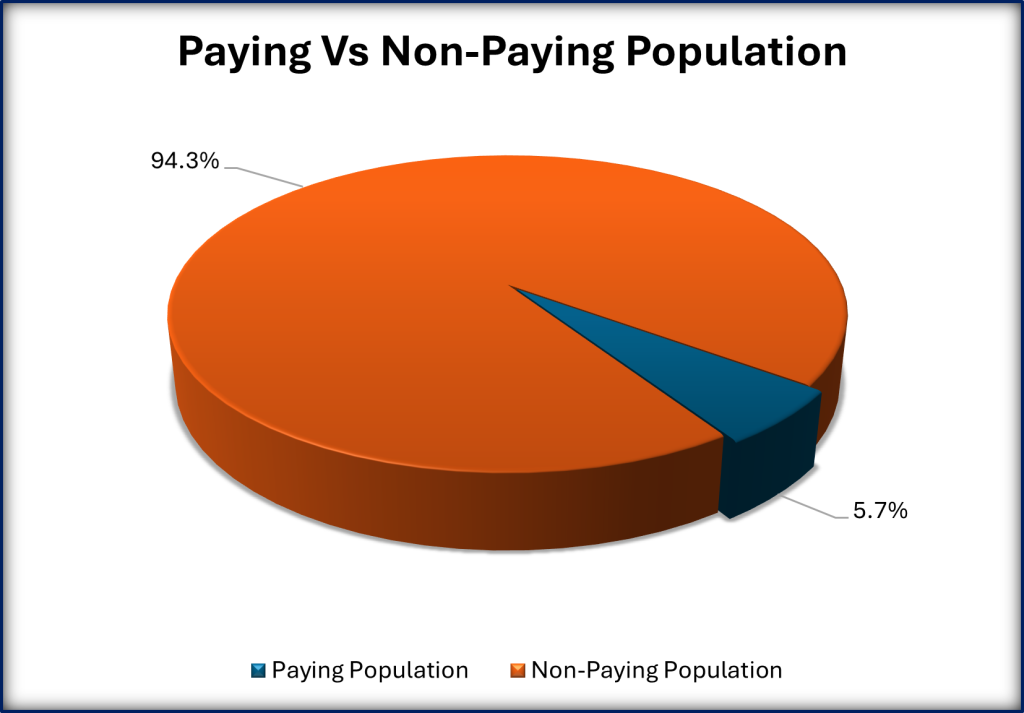
The graph indicates a concerning decline in lodgement compliance rates across the board. Concurrently, despite agriculture’s critical role in Fiji’s economy, its tax contribution remains remarkably low, showing only a marginal increase from 0.20% in 2022 to 0.25% in 2024, highlighting a significant disparity between the sector’s economic importance and its revenue generation for the tax system. Only 6% of the total taxpayer population is actively contributing.
Risk Areas and Mitigation Strategies
By working closely with key stakeholders and providing targeted support through Agriculture Compliance Kiosks and digital services, FRCS is committed to promoting fair and transparent compliance across the Agriculture Industry — ensuring that all taxpayers contribute their fair share while supporting sustainable growth in Fiji’s rural economy.
| Risk Area | Description | Mitigation Strategy |
|---|---|---|
| Abuse / Misinterpretation of Concessions | Middlemen incorrectly claim agricultural concessions intended for primary producers. | Clarify eligibility through updated guidelines; conduct targeted audits of middlemen; partner with the Ministry of Agriculture, AgroMarketing Fiji, and other industry association to ensure proper application of concessions. |
| Incorrect Claim of Agricultural Income Exemption | Some agricultural businesses exceed the FJD 500,000 turnover threshold but continue to claim full exemption, under-declaring taxable income. | FRCS is strengthening data matching across MoU Partners to identify taxpayers whose agricultural income exceeds the FJD 500,000 threshold. We are conducting targeted education campaigns to clarify exemption rules and obligations. Risk Engine analysis will trigger audits where turnover discrepancies are identified, and non-compliant taxpayers will be subject to reassessment and penalties where applicable. |
| Underreporting & Informal Transactions | Income through middlemen is often unreported; cash transactions dominate. | Apply third-party verification and cross-check data with buyers/processors; strengthen data sharing agreements with the Sugar Cane Growers Fund, AgroMarketing Fiji, Fiji Crop and Livestock Council, and other industry associations to improve transparency. |
| Cartage Providers / Transporters | Income earned by cartage providers is often underreported or misclassified under concessions. | Issue standard deduction guidelines; conduct targeted audits of cartage providers; collaborate with key sector stakeholders to improve understanding of reporting obligations. |
| Monitoring of Expired Tax Exemptions for Cooperatives | Some cooperatives that were granted income tax exemptions (up to 5 years or 8 years) continue to incorrectly claim exemption or fail to resume full tax filing after the exemption period ends. This results in under-declared income and tax leakage | FRCS is strengthening monitoring of cooperative exemptions. Pre-expiry alerts will be sent through TPOS. Post-exemption compliance checks will be triggered via the Risk Engine. FRCS will collaborate with the Department of Cooperatives and sector bodies to educate cooperatives on their filing obligations and ensure timely transition to full compliance after the exemption period. |
| Low Filing / Lodgment Rates | Significant decline in CIT, PIT, and VAT lodgment within the sector. | Expand TPOS online filing support in rural areas; set up Agriculture Compliance Kiosks during agricultural events and in rural hubs, providing farmers and stakeholders with information, education, and filing assistance. |
| High-Risk Taxpayer Segments | Risk Engine identifies 15.34% of high-risk taxpayers in agriculture. | Use Risk Engine profiles for targeted education, audits, and enforcement; leverage partnerships with the Sugar Cane Growers Fund, AgroMarketing Fiji, the Ministry of Agriculture, the Fiji Crop and Livestock Council and other industry association to support accurate tax reporting and promote compliance across the industry. |
Last Updated - April 27, 2026