FRCS Participates in the REACH Program


The Fiji Revenue and Customs Service (FRCS) is pleased to share progress on the journey to achieve the complete removal of Fiji from the European Union’s (EU) list of non-cooperative jurisdictions, commonly known as the EU Blacklist.
Fiji was initially placed on the list in 2019 due to concerns over compliance with the EU’s international tax standards in three key areas: transparency, fair taxation, and the implementation of the Base Erosion and Profit Shifting (BEPS) minimum standards. The initiative to remove Fiji from the EU Blacklist was formally commenced in 2023 with the joining of the BEPS inclusive framework and becoming a member of the Global Forum which is an agency of the OECD.
To meet international standards of transparency, Fiji has become a committed member of the Global Forum on Tax Transparency and Exchange of Information for Tax Purposes. This membership is a major step forward and demonstrates our resolve to operate with openness and integrity in the global financial system.
FRCS has been working closely with the Global Forum to put in place systems for both the Exchange of Information on Request (EOIR) and Automatic Exchange of Information (AEOI). These are key tools that allow countries to share tax information and combat cross-border tax evasion.
As part of this process, a comprehensive maturity assessment was conducted across various arms of government, including the Ministry of Finance, Ministry of Justice, Fiji Financial Intelligence Unit (FFIU), Reserve Bank of Fiji, Association of Banks, and Fiji Institute of Chartered Accountants. This assessment confirmed Fiji’s strong legal framework to support international tax cooperation.
Fiji’s commitment was further reinforced during a recent high-level visit by the Head of the Global Forum, Ms. Zayda Manatta. Her visit helped raise awareness at both the political and technical levels on the importance of investing in tax transparency. The delegation met with key stakeholders including Assistant Minister for Finance Hon. Esrom Emmanuel, Attorney-General Hon. Graham Leung, Permanent Secretary for Foreign Affairs Dr. Raijeli Taga, Governor of the Reserve Bank Mr. Ariff Ali, Director of FFIU Ms. Caroline, and Administrator-General of the Ministry of Justice Ms. Treta Sharma.

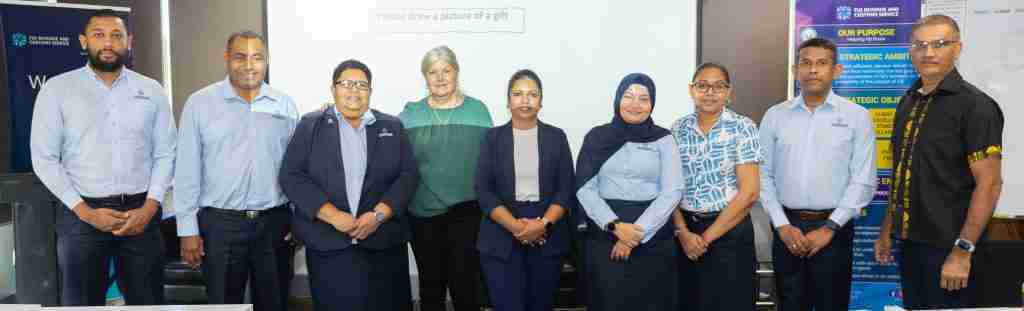
From left FRCS Technical Specialist International, Ms. Ronika Sharma, Manager International Relations, Mr. Mohnish Prasad, Global Forum delegate, Mr. Hakim Hamadi, Head of Global Forum Secretariat, Ms. Zayda Manatta, FRCS CEO, Mr. Udit Singh, Director Corporate Services, Mr. Shavindra Nath, Global Forum delegate, Ms. Aurore Arcambal and Senior Technical Specialist International, Mr. Anish Kumar.

FRCS and team from the Global Forum on Transparency and Exchange for Tax Purposes meeting with the Assistant Minister of Finance, Mr. Esrom Immanuel
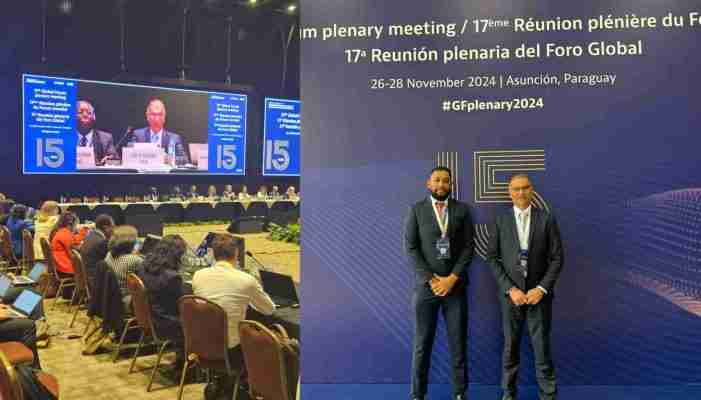
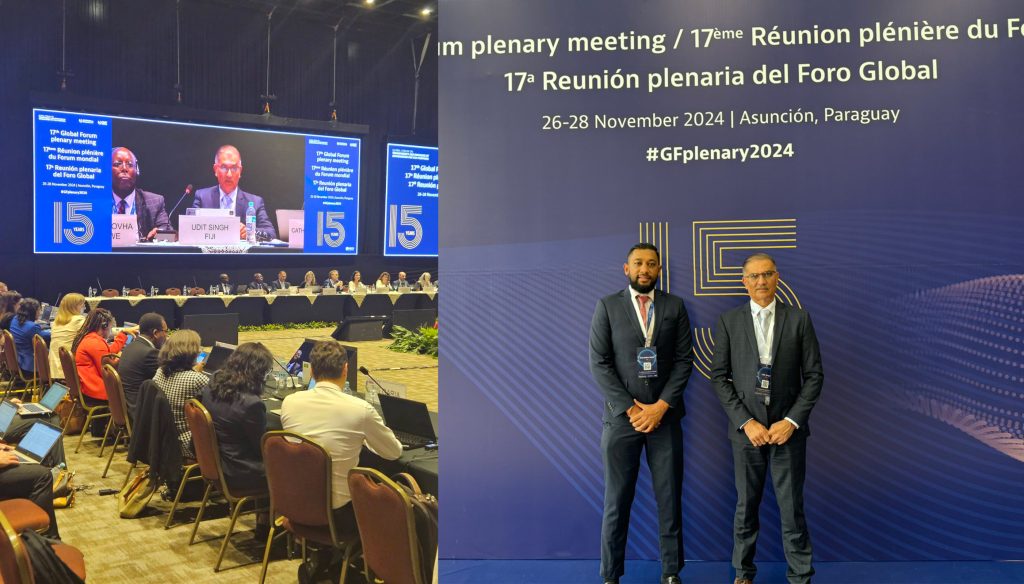
Additionally, the Chief Executive Officer, Mr. Udit Singh, along with the Director of Corporate Services, Mr. Shavindra Nath, participated in the 17th Plenary Meeting of the Global Forum on Transparency and Information Sharing held in Asuncion, Paraguay in November 2024. Mr. Singh delivered a speech at the event, which was attended by representatives from 110 countries, reaffirming Fiji’s strong commitment to international tax cooperation.

| FRCS CEO, Mr Udit Singh and Director of Corporate Services, Mr. Shavindra Nath, at the 17th Plenary Meeting of Global Forum on Transparency and Information Sharing held in Asuncion, Paraguay in November 2024. |
To address EU concerns around fair taxation, Fiji reviewed and reformed several tax incentive policies. The Export Income Deduction, ICT income tax exemption, and the concessionary corporate tax rate for Global Headquarters Relocation were identified by the EU as harmful tax practices.
Fiji has taken firm action on abolishing the Global Headquarters Relocation incentive and amending the ICT incentive to remove harmful elements. These changes reflect our alignment with the EU Code of Conduct Group’s standards and underscore Fiji’s readiness to support fair and competitive tax practices.
On the BEPS front, Fiji is now an active member of the BEPS Inclusive Framework. Through this, we are fully engaged in implementing the four internationally agreed minimum standards to tackle tax avoidance and improve tax fairness.
FRCS, together with other arms of government, remains fully committed to the steps necessary for Fiji’s complete removal from the EU Blacklist. We will continue to actively engage with international bodies and the EU officials to ensure our tax system remains transparent, fair, and aligned with global best practices.
Fiji is making real progress, and we are confident that our efforts will lead to a positive outcome for the country and its global reputation resulting in further trade and investment opportunities from European organisations.

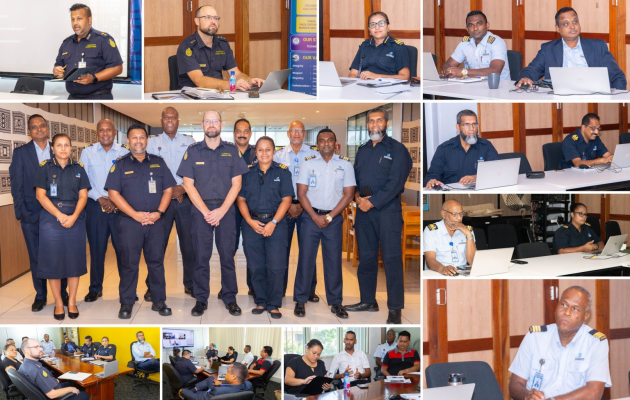
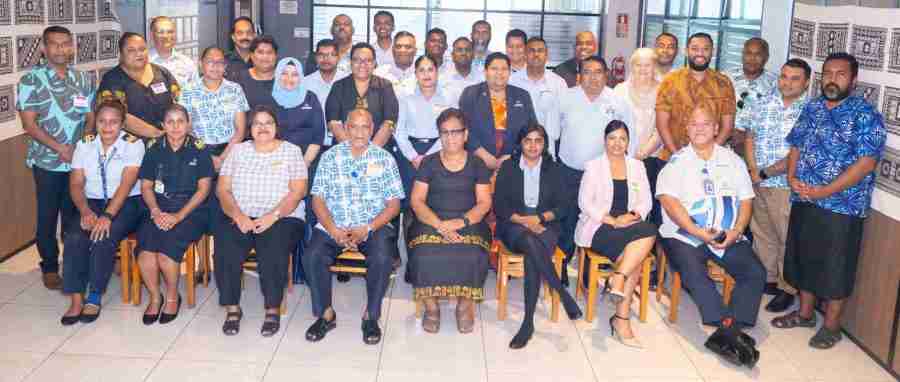
As part of its two-week technical mission from 31 March to 11 April 2025 on tax expenditure costing and evaluation, the International Monetary Fund (IMF) Mission team conducted a comprehensive two-day workshop with the teams from FRCS and Ministry of Finance (MOF) to share their findings on Tax Expenditure (TE).
Held at the FRCS headquarters in Nasese, Suva, the workshop featured in-depth discussions on key areas of tax expenditure, including Value Added Tax (VAT), Customs and Excise Tax, Corporate Income Tax (CIT), and Personal Income Tax (PIT). This event served as a valuable platform for exchanging insights and promoting a deeper understanding of these critical fiscal matters.
Tax expenditure reporting refers to the process of identifying and accounting for the fiscal impact of government support provided through the tax system. While direct expenditure policies are typically well-documented in national budgets, comparable transparency is often lacking for tax-related support measures.
TE reporting addresses this gap by enhancing fiscal transparency and supporting more effective policy evaluation. It enables both the government and the public to better understand which sectors or activities are receiving support through tax provisions, offering a clearer view of fiscal policy priorities. Furthermore, it serves as a crucial starting point for assessing the effectiveness of current policies and informing potential reforms.


The Fiji Revenue and Customs Service (FRCS) recently convened its inaugural forum for the legal fraternity, focusing on tax compliance and customer advocacy, with a particular emphasis on Capital Gains Tax (CGT).
Held at the FRCS Headquarters in Suva, this forum provided a valuable platform for the Tax Office to engage in open and constructive dialogue under the theme, “Working together to achieve tax compliance and customer advocacy—helping customers and Fiji grow.”
In his welcome address, FRCS Chief Executive Officer, Mr. Udit Singh, highlighted the critical role of legal services for the majority of taxpayers, underscoring the importance of a collaborative approach with the legal fraternity.

“The forum aims to foster a productive and collaborative relationship between the legal fraternity and FRCS. It is designed to facilitate listening, gathering feedback, and implementing improvements to business processes, with a dual focus on enhancing customer experience and developing a trusted partnership with taxpayers and legal professionals,” Mr. Singh stated.
“By sharing our perspectives and expertise, we can identify areas of common ground and collaborate on solutions that will benefit our customers. Our collaborative approach will achieve several key outcomes, including taxpayer confidence, fairness, and transparency, ensuring that taxpayers’ rights are safeguarded, and the tax system is improved,” he stated.
Highlighting the strategic objectives of the Tax Office, FRCS Director of Taxation, Ms. Momina Beg, noted that FRCS had enhanced its customer engagement strategies by implementing tailored, industry-focused services aimed at improving the overall taxpayer experience.
While legal professionals administer several tax processes, this forum concentrated on CGT. CGT is levied on profits or gains realized from the disposal of capital assets at a rate of 10 percent.
According to Ms. Beg, real-time data from the Taxpayer Online Service (TPOS) revealed that as of February 2025, the expected CGT returns to be filed were 16,268, but only 10,107 were actually filed, resulting in a 38 percent non-compliance rate.
She proposed several areas for improvement to the legal professionals to enhance compliance with CGT and encouraged them to utilize TPOS to streamline their tax-related tasks.
Ms. Beg further stated that FRCS has undertaken several initiatives to facilitate compliance with the CGT process. These initiatives include enhancing CGT processes on TPOS based on customer feedback, adding additional valuers to the panel for providing valuation services to taxpayers, boosting educational materials and services on CGT, and creating a dedicated email address for CGT inquiries: cgt@frcs.org.fj.
Additionally, representatives from the legal fraternity, Mr. Subhash Parshotam and Registrar of Titles Ms. Torika Goneca, also made presentations at the forum. It was an interactive event where questions from the legal fraternity were addressed by the FRCS team, fostering an open dialogue between FRCS and the legal professionals.
FRCS plans to convene additional forums in the future.


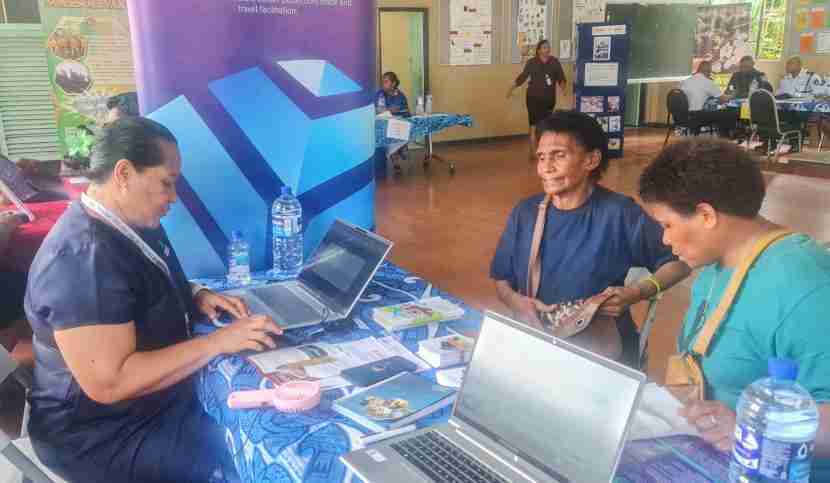
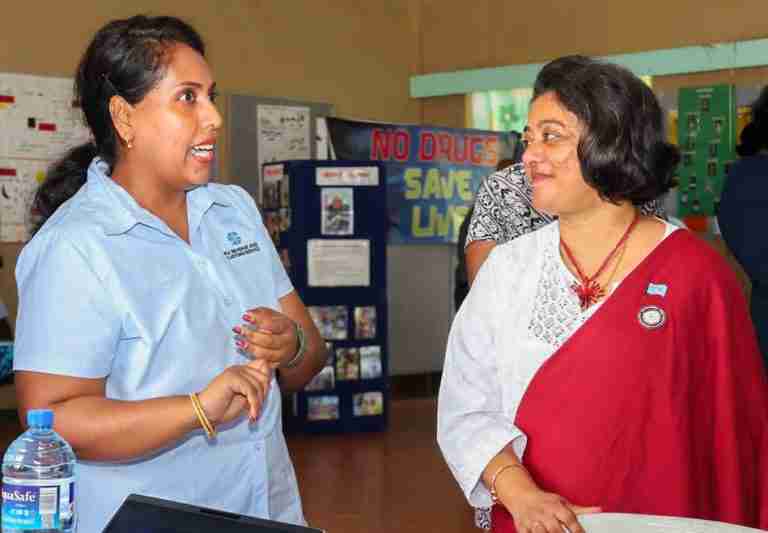
We were pleased to receive an invitation to Koro Island to conduct awareness sessions and facilitate various registrations and applications. Our dedicated team, comprising Isireli Masiwini from the Border and Customs Division, along with Laisa Draunibaka and Ilaisa Ralulu from the Taxation Division, embarked on this mission with great enthusiasm.
The visit proved to be exceptionally productive, as the team successfully engaged with 14 villages, one secondary school, and three primary schools across the island. The response from the villagers was overwhelmingly positive, with many expressing their gratitude for FRCS’s efforts to bring essential services directly to their communities.
During their stay, the FRCS team provided a comprehensive range of services, including the registration of new individual, non-individual, and sole trader Taxpayer Identification Numbers (TIN), processing applications for Tax Compliance Certificates, and reprinting TIN letters and Joint ID Cards.
Additionally, the team conducted informative awareness sessions for business owners, educating them on their tax obligations and expectations from FRCS. They also demonstrated how to use the Taxpayer Online Service (TPOS) and provided financial literacy training to assist with tax return filings.
The visit to Koro Island was a testament to FRCS’s commitment to making its services accessible and ensuring that all citizens are well-informed and compliant with tax regulations.