
Undeclared Firearms Seized from Yacht at Savusavu Port

The Fiji Revenue and Customs Service (FRCS) intercepted a foreign-flagged yacht upon its arrival at Savusavu Port this week.

An advance notification of arrival was submitted prior to docking, which was duly assessed for risk indicators. During this assessment, several red flags were identified, prompting FRCS maritime officers to carry out a targeted inspection of the vessel.

The search led to the discovery of two semi-automatic pistols, 30 pieces of C02 cartriage and 1138 pallets that were not declared by the yacht’s skipper. Under Fiji’s Arms and Ammunition Act, all firearms and ammunition are strictly regulated. Permits and licenses are required for the possession of such items, while transit vessels are obligated to declare them in advance.

The matter has since been referred to the Fiji Police Force for further investigation.

FRCS reminds all travelers, including yacht owners and sailors, to make accurate and complete declarations when submitting advance arrival information. Failure to do so will result in enforcement action under the law.

FRCS remains committed to protecting Fiji’s borders and ensuring compliance with all regulatory requirements.

Undeclared Firearms Seized from Yacht at Savusavu Port

The Fiji Revenue and Customs Service (FRCS) intercepted a foreign-flagged yacht upon its arrival at Savusavu Port this week.

An advance notification of arrival was submitted prior to docking, which was duly assessed for risk indicators. During this assessment, several red flags were identified, prompting FRCS maritime officers to carry out a targeted inspection of the vessel.

The search led to the discovery of two semi-automatic pistols, 30 pieces of C02 cartriage and 1138 pallets that were not declared by the yacht’s skipper. Under Fiji’s Arms and Ammunition Act, all firearms and ammunition are strictly regulated. Permits and licenses are required for the possession of such items, while transit vessels are obligated to declare them in advance.

The matter has since been referred to the Fiji Police Force for further investigation.

FRCS reminds all travelers, including yacht owners and sailors, to make accurate and complete declarations when submitting advance arrival information. Failure to do so will result in enforcement action under the law.

FRCS remains committed to protecting Fiji’s borders and ensuring compliance with all regulatory requirements.
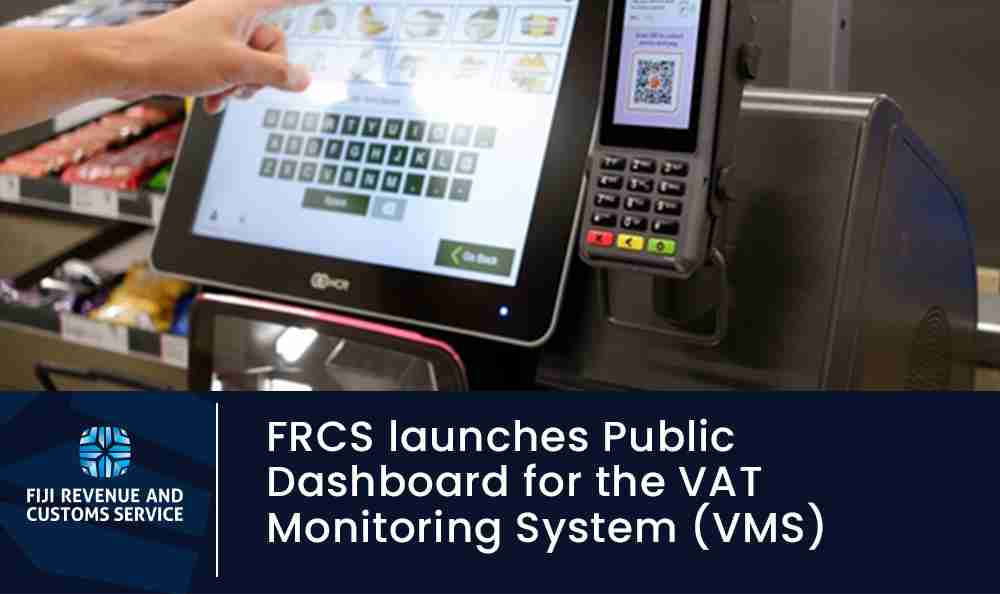

FRCS LAUNCHES PUBLIC DASHBOARD FOR THE VAT MONITORING SYSTEM (VMS)

The Fiji Revenue and Customs Service (FRCS), in partnership with Data Tech International (DTI), today announced the launch of a new public dashboard for the VAT Monitoring System (VMS). The platform offers citizens and businesses a clear, daily-updated view of Fiji’s fiscalization progress and introduces tools for direct public participation in VAT compliance.

The dashboard, accessible through the FRCS VMS portal, displays indicators refreshed daily, including the number of fiscalized taxpayers and business locations, activated secure elements, recorded sales, invoice volumes, and receipt verifications. Users may filter data by administrative area to understand local trends, while integrated tools allow the public to verify invoices, report when fiscal invoices are not issued, and flag suspicious receipts.

“This launch is both a transparency milestone and a practical step toward fair competition,” said FRCS Chief Executive Officer Mr. Udit Singh. “By expanding VMS coverage to new sectors and opening access to real-time indicators, the public can see progress, understand expectations, and play an active role by verifying receipts. It sends a clear message that the rules apply equally and that honest businesses will not be undercut by non-compliance.”

DTI Chief Executive Officer Mr. Goran Todorov emphasized the system’s accessibility. “DTI is proud to support FRCS with a tested, reliable, and mobile-friendly dashboard designed for every Fijian. By combining daily data, local drill-downs, and easy reporting tools, we strengthen trust in the tax system and support FRCS’s modernization efforts.”

The initiative coincides with FRCS’s phased expansion of VAT monitoring to business sectors previously outside scope, reinforcing a level playing field and ensuring all taxpayers meet their obligations.

What the public can do on the VMS portal:

  • Verify whether an invoice is valid (with or without a QR code).
  • Report non-issuance of a fiscal invoice.
  • Flag suspicious invoices for further review.
  • Explore daily VMS metrics and trends, including views by province or area.

FRCS is urging businesses to maintain compliance and encouraging citizens to make use of the portal. “Transparency protects compliant taxpayers, informs smart enforcement, and builds public confidence that the system is fair,” Mr. Singh added.

The Public VAT Monitoring Dashboard is now live and accessible at: https://vms.frcs.org.fj/

FRCS LAUNCHES PUBLIC DASHBOARD FOR THE VAT MONITORING SYSTEM (VMS)

The Fiji Revenue and Customs Service (FRCS), in partnership with Data Tech International (DTI), today announced the launch of a new public dashboard for the VAT Monitoring System (VMS). The platform offers citizens and businesses a clear, daily-updated view of Fiji’s fiscalization progress and introduces tools for direct public participation in VAT compliance.

The dashboard, accessible through the FRCS VMS portal, displays indicators refreshed daily, including the number of fiscalized taxpayers and business locations, activated secure elements, recorded sales, invoice volumes, and receipt verifications. Users may filter data by administrative area to understand local trends, while integrated tools allow the public to verify invoices, report when fiscal invoices are not issued, and flag suspicious receipts.

“This launch is both a transparency milestone and a practical step toward fair competition,” said FRCS Chief Executive Officer Mr. Udit Singh. “By expanding VMS coverage to new sectors and opening access to real-time indicators, the public can see progress, understand expectations, and play an active role by verifying receipts. It sends a clear message that the rules apply equally and that honest businesses will not be undercut by non-compliance.”

DTI Chief Executive Officer Mr. Goran Todorov emphasized the system’s accessibility. “DTI is proud to support FRCS with a tested, reliable, and mobile-friendly dashboard designed for every Fijian. By combining daily data, local drill-downs, and easy reporting tools, we strengthen trust in the tax system and support FRCS’s modernization efforts.”

The initiative coincides with FRCS’s phased expansion of VAT monitoring to business sectors previously outside scope, reinforcing a level playing field and ensuring all taxpayers meet their obligations.

What the public can do on the VMS portal:

  • Verify whether an invoice is valid (with or without a QR code).
  • Report non-issuance of a fiscal invoice.
  • Flag suspicious invoices for further review.
  • Explore daily VMS metrics and trends, including views by province or area.

FRCS is urging businesses to maintain compliance and encouraging citizens to make use of the portal. “Transparency protects compliant taxpayers, informs smart enforcement, and builds public confidence that the system is fair,” Mr. Singh added.

The Public VAT Monitoring Dashboard is now live and accessible at: https://vms.frcs.org.fj/

FRCS Maritime Seaport Seizes Over 57,000 Illicit Cigarette Sticks in the Last Financial Year

The Fiji Revenue and Customs Service (FRCS) Maritime Seaport Enforcement Team successfully intercepted 57,740 undeclared cigarette sticks during the last financial year. Cigarettes are classified as highly dutiable goods and are often smuggled by seafarers upon arrival at ports of entry.



Revenue leakage occurs when such goods are not declared at the time of arrival with the intent to evade lawful payment of import duties. These practices undermine government revenue, which is vital for sustaining national development.

FRCS enforcement officers remain steadfast in their commitment to detecting, intercepting, and preventing illegal activities to protect revenue collection and ensure full compliance with customs laws and regulations.

We strongly urge all travellers, seafarers, and shipping agents to make honest and accurate declarations of their goods upon arrival. Non-compliance will result in penalties and legal action under the applicable laws.

FRCS will continue to strengthen border control measures and safeguard government revenue, ensuring it supports the sustainable growth and development of our nation.

FRCS Chief Executive Officer, Mr. Udit Singh, stated:

“This interception is another reminder of the crucial role FRCS plays in protecting Fiji’s borders and safeguarding government revenue. Smuggling not only deprives the nation of much-needed funds for development, but also undermines fairness for compliant taxpayers and businesses. We remain fully committed to enforcing our laws and will continue to adopt stronger measures to ensure integrity and compliance across all ports of entry.”

FRCS Maritime Seaport Seizes Over 57,000 Illicit Cigarette Sticks in the Last Financial Year

The Fiji Revenue and Customs Service (FRCS) Maritime Seaport Enforcement Team successfully intercepted 57,740 undeclared cigarette sticks during the last financial year. Cigarettes are classified as highly dutiable goods and are often smuggled by seafarers upon arrival at ports of entry.

Revenue leakage occurs when such goods are not declared at the time of arrival with the intent to evade lawful payment of import duties. These practices undermine government revenue, which is vital for sustaining national development.

FRCS enforcement officers remain steadfast in their commitment to detecting, intercepting, and preventing illegal activities to protect revenue collection and ensure full compliance with customs laws and regulations.

We strongly urge all travellers, seafarers, and shipping agents to make honest and accurate declarations of their goods upon arrival. Non-compliance will result in penalties and legal action under the applicable laws.

FRCS will continue to strengthen border control measures and safeguard government revenue, ensuring it supports the sustainable growth and development of our nation.

FRCS Chief Executive Officer, Mr. Udit Singh, stated:

“This interception is another reminder of the crucial role FRCS plays in protecting Fiji’s borders and safeguarding government revenue. Smuggling not only deprives the nation of much-needed funds for development, but also undermines fairness for compliant taxpayers and businesses. We remain fully committed to enforcing our laws and will continue to adopt stronger measures to ensure integrity and compliance across all ports of entry.”

FRCS Contributes to Fiji’s Participation in Asia Pacific Group Mutual Evaluation Committee Meetings

FRCS was honoured to be part of the Fiji delegation attending the Mutual Evaluation Committee (MEC) meetings of the Asia Pacific Group on Money Laundering (APG), held in Tokyo, Japan. The delegation was led by Ms. Selina Kuruleca, Permanent Secretary for Justice, in her capacity as Chair of the Anti-Money Laundering (AML) Council. Our Manager Risk Assessment & Financial Intelligence, Mr Rohitesh Dass represented FRCS at the MEC meetings.
 
FRCS’s participation in these high-level discussions reflects its critical role in Fiji’s national framework for combating money laundering and terrorist financing. As a key agency responsible for monitoring cross-border financial flows and enforcing customs regulations, FRCS contributes significantly to the integrity and effectiveness of Fiji’s AML/CFT (Combating the Financing of Terrorism) regime.
The MEC meetings provided a valuable platform for Fiji to strengthen regional and international cooperation, share best practices, and prepare for its upcoming mutual evaluation scheduled for late 2025 and into 2026. Discussions focused on:
  •  Technical assistance and capacity-building initiatives
  •  Reviews of recent evaluations of other jurisdictions
  •  Identifying sectoral gaps and opportunities for improvement in AML/CFT efforts
FRCS continues to play a pivotal role in safeguarding Fiji’s financial system from illicit activities, working in close partnership with other national and international stakeholders to uphold transparency, accountability, and security. By learning from the experiences of others and engaging with international partners, FRCS as well as Fiji is committed to continuously improving its AML/CFT (Combating the Financing of Terrorism) framework.

FRCS Contributes to Fiji’s Participation in Asia Pacific Group Mutual Evaluation Committee Meetings

FRCS was honoured to be part of the Fiji delegation attending the Mutual Evaluation Committee (MEC) meetings of the Asia Pacific Group on Money Laundering (APG), held in Tokyo, Japan. The delegation was led by Ms. Selina Kuruleca, Permanent Secretary for Justice, in her capacity as Chair of the Anti-Money Laundering (AML) Council. Our Manager Risk Assessment & Financial Intelligence, Mr Rohitesh Dass represented FRCS at the MEC meetings.

FRCS’s participation in these high-level discussions reflects its critical role in Fiji’s national framework for combating money laundering and terrorist financing. As a key agency responsible for monitoring cross-border financial flows and enforcing customs regulations, FRCS contributes significantly to the integrity and effectiveness of Fiji’s AML/CFT (Combating the Financing of Terrorism) regime.

The MEC meetings provided a valuable platform for Fiji to strengthen regional and international cooperation, share best practices, and prepare for its upcoming mutual evaluation scheduled for late 2025 and into 2026. Discussions focused on:

  •  Technical assistance and capacity-building initiatives
  •  Reviews of recent evaluations of other jurisdictions
  •  Identifying sectoral gaps and opportunities for improvement in AML/CFT efforts

FRCS continues to play a pivotal role in safeguarding Fiji’s financial system from illicit activities, working in close partnership with other national and international stakeholders to uphold transparency, accountability, and security. By learning from the experiences of others and engaging with international partners, FRCS as well as Fiji is committed to continuously improving its AML/CFT (Combating the Financing of Terrorism) framework.