
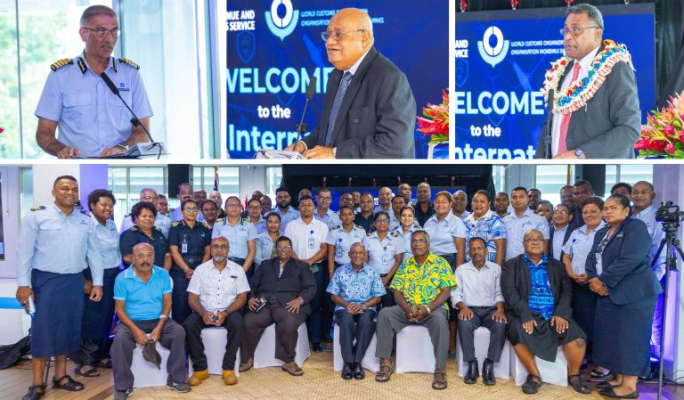
FRCS Commemorates International Customs Day 2026
The Fiji Revenue and Customs Service (FRCS) marked the 2026 International Customs Day (ICD) with an official ceremony at its Headquarters in Nasese, officiated by the Minister for Finance, Commerce and Business Development, Hon. Esrom Yosef Immanuel. The Minister was honoured with a full traditional welcome by FRCS Customs officers.
Observed globally on 26 January, International Customs Day celebrates the essential role Customs administrations play in facilitating trade, securing borders, and protecting communities.
This year’s theme— “Customs: Protecting Society Through Vigilance and Commitment”—underscores the critical responsibility Customs officers hold in safeguarding citizens, ensuring secure and lawful trade, and responding proactively to emerging border threats.
Hon. Immanuel highlighted the significance of this year’s theme, noting that Customs operations have evolved far beyond revenue collection. “Customs today is undeniably a frontline guardian of society. Across the world, and here at home, Customs officers work at the intersection of border security and trade facilitation. Every container examined, every passenger screened, and every document verified represents a decision with national impact. Vigilance is not optional—it is the foundation of our work.”
He noted that increasingly complex global supply chains, expanding criminal networks, and emerging security threats have amplified the importance of Customs.
“Illicit drugs, prohibited weapons, counterfeit goods, environmental crimes, and transnational fraud seek to exploit border vulnerabilities. Customs is our first—and often last—line of defence,” Hon Immanuel. stated.
FRCS Board Chair, Mr. Malakai Naiyaga, reinforced the pivotal national role that Customs plays.
According to Mr. Naiyaga, from a governance perspective, Customs is one of Fiji’s most consequential public institutions. “The decisions made at our borders influence economic confidence, public safety, and the nation’s global reputation, “he stated.
He commended Customs officers for their professionalism and integrity: “Our officers consistently balance firmness with fairness, ensuring enforcement while enabling legitimate trade. Their work protects communities and supports Fiji’s broader development ambitions.”
Mr. Naiyaga also emphasized that effective border management demands strong partnerships across government agencies, private-sector stakeholders, regional counterparts, and the international community.
“These partnerships are essential. Risks today are shared, and so too must be our solutions. We thank all our partner agencies—local and international—for their continued support.”
He also acknowledged the commitment of FRCS leadership and staff navigating an environment of rapid change and evolving challenges. “Progress requires vision, discipline, and a willingness to adapt while holding firm to core principles. That balance is not easy, but it is being pursued with purpose.”
Addressing Customs officers directly, he added: “Your work matters. Your professionalism matters. Above all, your integrity matters. The nation is safer, stronger, and more resilient because of your commitment.”
During the ceremony, twenty FRCS officers and stakeholders were recognised with the World Customs Organization (WCO) Certificate of Merit for their contribution to trade facilitation, border protection, and revenue integrity.
FRCS also introduced the Yacht Management System (YMS) as part of its broader digital transformation agenda.
FRCS Chief Executive Officer, Mr. Udit Singh, noted the global shift toward digital, paperless Customs environments.
“Around the world, Customs administrations are moving decisively toward paperless processes, Single Window systems, and intelligence-led border management—not as optional reforms, but as necessities. Fiji is equally committed to this transformation.”
Introducing the YMS, Mr. Singh highlighted its significance: “The Yacht Management System marks a shift from manual, fragmented processes to a digital, integrated, and risk-based approach. It supports Single Window processing, reduces duplication, and enhances information-sharing across agencies.”
He added that digitisation enables Customs officers to prioritise risk-based interventions.
“By reducing paper-based processing, we improve efficiency, lower costs for government and industry, and allow our officers to focus on intelligence-driven decision-making. As yacht movements increase, this system ensures Customs remains agile, cost‑effective, and secure.”
The YMS reflects FRCS’s commitment to smart regulation, balancing facilitation of legitimate trade with strengthened border security.
Last Updated - February 3, 2026