
FRCS Participates in Study Visit to Australian Border Force
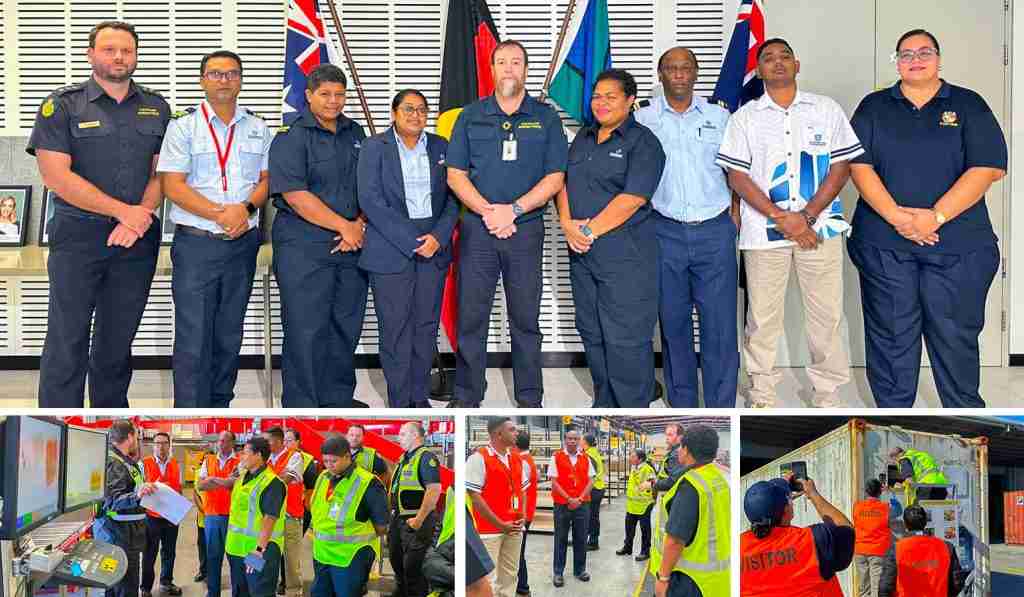 Six Customs officers from various divisions of FRCS recently participated in a three-day study visit to the Australian Border Force (ABF). This collaborative initiative was jointly organized by the United Nations Office on Drugs and Crime (UNODC) and ABF, with technical funding support provided by the UK Government.
Led by Acting Chief Customs Officer Mr. Robeen Chand, the FRCS delegation engaged in an in-depth exploration of emerging border-related crimes, including serious non-compliance and criminal activities within the trade environment and the challenges that continue to impact FRCS operations. The visit aimed to enhance FRCS’s capabilities in virtual profiling and targeting, managing border risks associated with both known and unknown entities in the supply chain, and improving the integrity of cargo reporting. A key objective was to strengthen the detection of criminal networks operating within international trade.
Participants were also introduced to advanced border control technologies, including large-scale x-ray container scanners equipped with image analysis capabilities. These tools enable Customs officers to identify inconsistencies in cargo, detect anomalies, and mitigate associated risks. At ABF’s modern facility in Brisbane, the team was provided with extensive research opportunities into various border risks, including methods used by criminal networks such as the “Rips Method,” “Dope on a Rope,” the use of duplicate container seals, and insider threats within trusted networks.
The study visit offered valuable insights into evolving trade patterns and border crime trends, allowing officers to trial alternative targeting approaches and methodologies aimed at enhancing trade enforcement capabilities.
FRCS remains committed to its ongoing collaboration with UNODC and ABF to continuously build capacity, re-skill its workforce, and strengthen intelligence-sharing with regional partners. These efforts are geared towards developing a more agile, intelligence-led risk management framework and leveraging Non-Intrusive Inspection Equipment (NIIE) to detect, disrupt, and dismantle transnational organized crime.
Looking ahead, FRCS is confident in expanding its operational capabilities through both intrusive and non-intrusive methods, which will be instrumental in the establishment of the upcoming Container Examination Facility (CEF).
FRCS extends its sincere appreciation to the UK Government for its generous support of this initiative, and to our technical border partners including UNODC and ABF for their continued engagement and contribution to resource development.
Last Updated - February 4, 2026