FRCS delivered an interactive webinar session for the members of the Fiji Hotel and Tourism Association (FHTA) on a number of industry-relevant taxation policies and processes including tax lodgment and payment due dates, changes in the 2024/2025 National Budget effective from 1st January 2025, taxation certificates, deadline for the phase 1 and 2 of the VAT Monitoring System (VMS), VAT deregistration process, updating business information on the Taxpayer Online Service (TPOS) and online payment. FHTA and FRCS regularly meet and collaborate on several issues including National Budget policies, status of Tourism Industry, risk management and capacity building.
The webinar offered an excellent opportunity for our team to provide insights into tax related issues specific to the Tourism industry to FHTA members. The members also discussed their existing or expected challenges related to taxes with our tax experts to see how both agencies can work together on pragmatic solutions. Our team was pleased to see the superb interaction and engagement from the participants. FRCS also appreciates the continued collaboration and commitment by FHTA members to meet their tax obligations.
We are extremely pleased to share that our MSME (Micro, Small and Medium Enterprise) team has successfully wrapped up a series of basic tax and financial literacy trainings for MSMEs in Lautoka and Suva which also included a customised training tailored specifically for the Nacula Homestay Operators.
Some of the topics covered during these trainings included business and tax registrations, bookkeeping, tax principles, financial literacy, Pay as You Earn (PAYE), provisional tax, online payments, lodgement of tax returns, preparation of profit and loss statements and balance sheets and payment obligations. The trainings were aimed at further enhancing awareness of tax obligations and promote voluntary compliance. Through the enhanced knowledge on accurate registration, bookkeeping and timely tax submissions, participants were encouraged to take proactive approach towards complying with the financial and tax obligations.
The customised trainings conducted for the Nacula Homestay Operators was particularly beneficial as it helped the Homestay Operators to better comprehend how to apply the general business and tax principles directly to their operations. All training sessions were very interactive and incorporated group exercises and discussions that engaged participants and allowed them to apply the knowledge gained. This hands-on approach further enhanced the learning experience of the participants, fostering greater understanding of the practical aspects of managing their finances and taxes.
FRCS provides a free-of-charge service to assist MSMEs to understand their tax obligations and become compliant and we encourage MSMEs to contact our team on 3243000 or 1326 or email at msme@frcs.org.fj for any assistance or advise required.
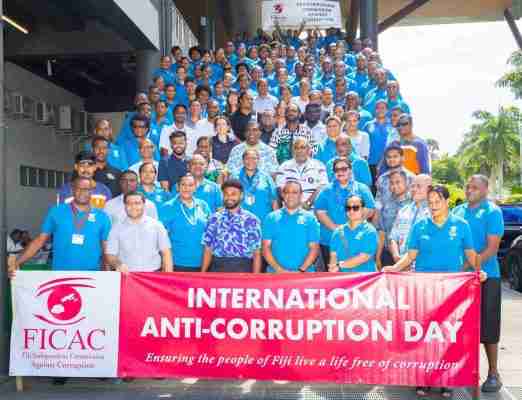
Taxes are the main sources of revenue for governments to fund public services and projects. Corruption, like tax evasion, also leads to erosion of government revenue. As such FRCS was pleased to collaborate with the Fiji Independent Commission Against Corruption (FICAC) and the relevant stakeholders to mark the International Anti-Corruption Day (IACD).
For FRCS, this was an imperative collaboration as it brought visibility to the issue of corruption and helped in informing the public about the detrimental effects of this deception on society, economy, and governance. We believe that a joint collaborative effort by all stakeholders will further amplify the message of anti-corruption and draw attention to the urgency of tackling corruption.
Our National Tariff and Technical Administration team had a very fruitful meeting with officials from the Japan Export Vehicle Inspection Center (JEVIC) to discuss enhancements to the offshore vehicle verification and inspection process.
JEVIC is responsible for conducting mandatory pre-shipment inspections for all used vehicles imported into Fiji from Japan, Australia, and New Zealand. The inspections ensure that vehicles meet safety, environmental, and import standards. This requirement has been in effect since 2016 and is crucial for customs clearance and vehicle registration in Fiji.
This collaborative effort aimed to improve the overall efficiency of the import licensing of the used vehicle. We are grateful for the continued support and assistance provided by the JEVIC to FRCS.
A recent joint operation between the Fiji Revenue and Customs Service (FRCS), the Fiji Police Force, and the Maritime Safety Authority of Fiji (MSAF) has successfully detected, disrupted, and detained multiple illegal activities. This collaborative effort underscores the importance of resource sharing and information exchange in achieving enforcement objectives.
The operation, conducted at the Mua-i-Walu port premises and nearby carrier stands, uncovered alarming evidence of high-value dutiable goods concealed in used water bottles. This sophisticated smuggling technique highlights the evolving methods employed by perpetrators and certain shop owners to evade customs regulations. Additionally, undeclared cigarettes were discovered on a fishing vessel, further exposing potential breaches of trade legislation involving shop owners and maritime operators.
The findings from these coordinated raids emphasize the critical need to safeguard Fiji’s supply chains from illegal activities. The FRCS and its partners remain steadfast in their commitment to disrupting these networks and ensuring compliance with the law.
FRCS CEO, Mr. Udit Singh stated that the results of the joint operation highlight the types of illicit activities designed to evade law enforcement. “We will continue to work collaboratively with our partners to ensure those engaging in illegal trade are held accountable under the law,” Mr. Singh said.
As we approach the festive season, FRCS is urging members of the public to remain vigilant and report any suspicious activities. Businesses are reminded to operate within the confines of the law, ensuring that all traded goods meet the legal requirements. Together, we can protect Fiji’s economy and ensure a safe and secure trading environment for all.
FRCS Surpasses Revenue Target in the First Four Months
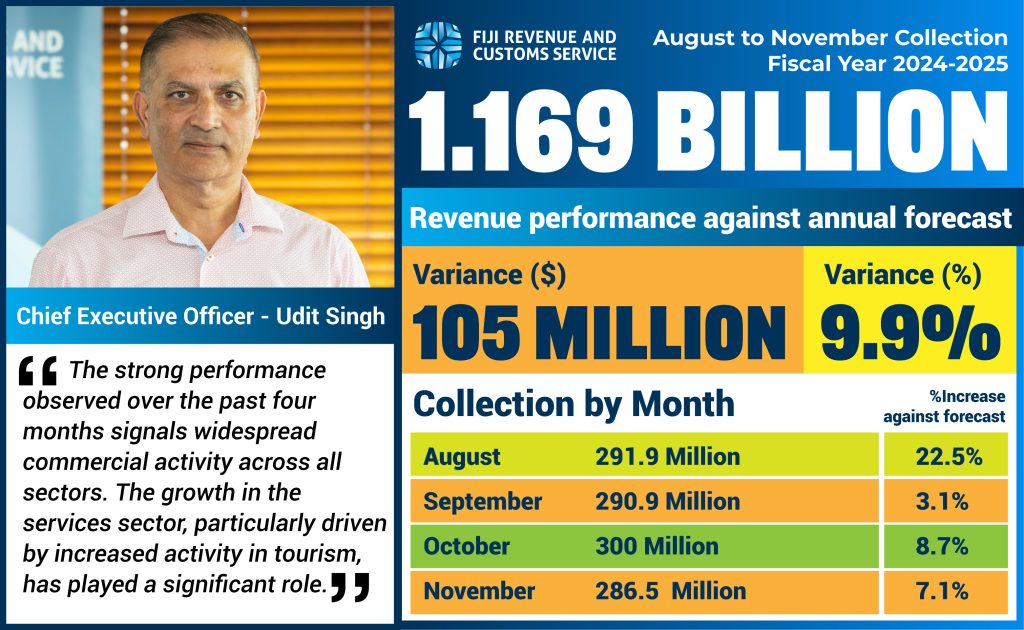
The Fiji Revenue and Customs Service (FRCS) has reported a net revenue collection totaling $1.169b at the end of the first four months of the 2024-2025 fiscal year, exceeding its forecast by $105.0m (9.9%) and reflecting an increase of $178.0m (18.0%) compared to the same period last year.
The positive outcomes stem from the consistent monthly performances. In August, collections stood at $291.9m, exceeding the forecast by $53.5m (22.5%). The strong performance set a positive tone for the months that followed. September continued this trend with a net revenue of $290.9m, surpassing the monthly forecast by $8.6m (3.1%). In October, revenue collection surged to $300.0m, representing a significant positive variance of $24.0m (8.7%) against the forecast. Additionally, in November, net revenue collection was $286.5 million, surpassing forecasts by $18.9m (7.1%). All major tax types including the Value Added Tax (VAT), Income Tax and Trade & Customs taxes have performed extremely well.
FRCS CEO, Mr. Udit Singh, credited the positive cumulative collections to the robust and strong performances across the key sectors of the economy as well FRCS compliance initiatives.
The strong performance observed over the past four months signals widespread commercial activity across all sectors. The growth in the services sector, particularly driven by increased activity in tourism, has played a significant role. Increased income tax payments resulting from improved business turnover and profitability, along with a substantial increase in VAT collections spurred by rising consumer demand, have also been pivotal, said Mr. Singh. Mr. Singh added that the ongoing strong revenue performance is also a result of improved compliance activities such as the VAT Compliance Drive and the positive contributions of the intense awareness and education programs along with the set-up of the new Post Assessment Verification Unit.
Looking ahead, Mr. Singh is optimistic that revenue projections for December 2024 and the other months will continue a similar trajectory.
The Ministry of Finance, in coordination with the Fiji Revenue and Customs Service (FRCS) has established an FRCS-led Tax Compliance Taskforce to prevent, detect and address tax evasion and avoidance as well as further strengthen tax compliance in Fiji.
Tax crimes are serious as they can negatively impact on revenue collection, undermine trust in the legal and financial system, and are also often linked to other serious crimes.
Chaired by the FRCS Board Member and a renowned and proficient Chartered Accountant, Mr. Nitin Gandhi, the Tax Compliance Taskforce aims to further strengthen tax compliance, prevent tax evasion, and enhance revenue collection through rigorous enforcement and collaborative efforts with relevant agencies and businesses
More specifically, the Taskforce will:
Review and recommend improvements to existing legislation and processes.
Review current processes and re-develop frameworks for investigating, enforcing and prosecuting undisclosed income and financial non-compliance.
Collaborate with key agencies to address tax evasion and financial crimes.
Utilize evidence-based information from various sources to support investigations
Implement measures to protect revenue and ensure compliance with legal standards.
Maintain strict data privacy and security protocols.
In addition to Mr. Gandhi, the other members of the Taskforce include former CEO of Fiji Revenue and Customs Authority (now FRCS), Mr. Jitoko Tikolevu, former acting Commissioner of Police, Mr. Rusiate Tudravu, anti-corruption and governance expert Mr. Avaneesh Anand Raman and risk and financial management expert, Mr. Pramesh Sharma.
The Taskforce has been appointed for an initial period of 12 months.
According to the Ministry of Finance, the Taskforce will take appropriate measures to ensure that the taxes owed are accurately collected through FRCS processes.
According to the FRCS CEO, Mr Udit Singh, the FRCS has all the baseline information on individual income.
More importantly, the Taskforce will operate in collaboration with, rather than supplanting, the role of the Commissioner of Tax under the FRCS Act, the Fiji Financial Intelligence Unit (FFIU), Fiji Independent Commission Against Corruption (FICAC), the Fiji Police Force, the Director of Public Prosecutions Office (DPP), and other relevant agencies,”. It will also collaborate with agencies of our international partners such as Australia and New Zealand
A framework is being developed for the Taskforce to have a defined structure and guidelines for operation and in the coming months they will also have a memorandum of understanding with other enforcement agencies.
FRCS Signs MOA With BRED Bank For Real-Time E- Payments For Tax
As part of its strategic focus to further enhance customer service and experience, the Fiji Revenue and Customs Service (FRCS) signed a Memorandum of Agreement (MOA) with the BRED Bank (Fiji) Pte Limited this morning, paving way for real-time e-payments for tax.
The MOA, signed by the FRCS CEO, Mr. Udit Singh, and the BRED Bank CEO, Mr. Pierre Tastet, will allow FRCS and BRED Bank to develop, operate and maintain an Application Program Interface (API) as part of the Taxpayer Online Service (TPOS) for real- time e-payments for tax.
Describing this initiative as a significant milestone for FRCS, Mr. Singh stated that the interface will allow BRED Bank customers to use their respective online banking portal to make payments to FRCS which will be validated in real-time against the specific tax types and accounts payable to FRCS.
According to Mr. Singh, the real-time payment mechanism is another addition to the e-services provided to FRCS customers.
“As taxpayers in Fiji use digital technology in more and more areas of their work, the introduction of the real-time e-payment service will be very beneficial to them. Business and individuals alike will benefit in many ways including making and having payments cleared faster and at a lower cost than using the traditional payment method and being able to manage day-to-day operations better with improved cash flow,” he said.
“FRCS is committed to further enhance its business processes not only focused on improving the customer experience but also reducing cost of doing business and closing tax gaps.”
FRCS is also working on having similar arrangements with the other banks in Fiji as well.
Mr. Singh thanked the team from BRED Bank for partnering with FRCS in this initiative and encouraged people to utilise the real-time e-payment service.
With the implementation of the new interface, taxpayers will be able to acquire from TPOS information on taxes that are due, amount payable as well as the penalties for overdue taxes. They can then log into their BRED Bank online banking portal and make their tax payments from anywhere and anytime. These payments will be reflected in real-time in the FRCS system and in the respective taxpayer’s ledger.
BRED Bank CEO Mr. Pierre Tastet said “Today, governments and businesses around the globe are moving away from legacy payment systems towards new platforms that can deliver payment services in a fast, safe and convenient manner. We are honour ed and thank FRCS in choosing BRED Bank to implement this real-time e-payment system in Fiji.”
“I encourage our BRED customers to fully utilize our digital platforms; BRED Fiji Connect for individual customers and BRED Business Connect for Corporate customers to experience speed, convenience and security in today’s fast paced world.” Mr. Pierre added.
In closing remarks, Mr. Pierre said “The financial landscape of transferring money and making payments has significantly evolved over the years and such investments do not come easy and cheap. We can all be proud of the substantial progress that has been made by both stakeholders in achieving this strategic objective.”




 Some of the topics covered during these trainings included business and tax registrations, bookkeeping, tax principles, financial literacy, Pay as You Earn (PAYE), provisional tax, online payments, lodgement of tax returns, preparation of profit and loss statements and balance sheets and payment obligations. The trainings were aimed at further enhancing awareness of tax obligations and promote voluntary compliance. Through the enhanced knowledge on accurate registration, bookkeeping and timely tax submissions, participants were encouraged to take proactive approach towards complying with the financial and tax obligations.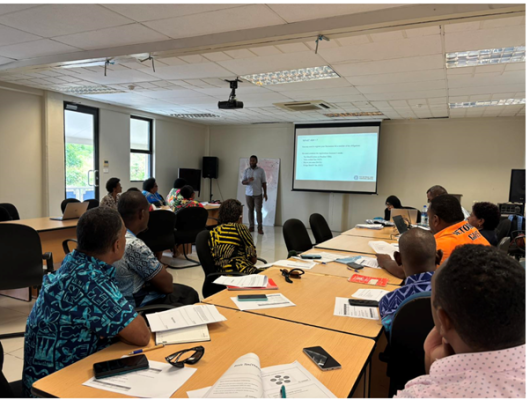
 corruption.

 The Fiji Revenue and Customs Service (FRCS) has reported a net revenue collection totaling $1.169b at the end of the first four months of the 2024-2025 fiscal year, exceeding its forecast by $105.0m (9.9%) and reflecting an increase of $178.0m (18.0%) compared to the same period last year.



 As part of its strategic focus to further enhance customer service and experience, the Fiji Revenue and Customs Service (FRCS) signed a Memorandum of Agreement (MOA) with the BRED Bank (Fiji) Pte Limited this morning, paving way for real-time e-payments for tax.